Friday, August 13, 2021

A Comforter, Shampoo Bottles, and Fear: What I Took to College

  I wrote this blog five years ago, when my first group of IB TOK seniors headed off to college. I have continued to revise and share it each year because the sentiment still remains the same. Today's blog is dedicated to anyone headed off to college this month--especially my former students from the Class of 2021 who I am going to miss when I head back to Room 211 in a few weeks. 


     I remember the car was filled to the brim when I went away to college. My dad is good at so many things, and I am sure from the looks of the picture below that my dad's "packing system" was unparalleled to none. I don't really remember how that empty car suddenly transformed into 18 years of life packed into one place, or where my brother, sister, and I sat. Yet, somehow we packed everything in and found a way for the five of us to get to Richmond. .
August 1993

My Dad and I right before I left for college

I felt like we had all of Costco in our van. We were never members of the megastore conglomerate, but weeks before I headed off to college, my mom took me there as her friend's guest to shop for "the essentials." Quite honestly, I felt like I was taking more to college than I ever would need. What I needed was courage. I needed friends. I needed grit and determination. I needed self-confidence. I needed to know how to balance a checkbook and make a long distance phone call (real struggles in the world before Venmo and on-line banking and cell phones). Yet, as we made our way down the driveway, headed seven hours south to the University of Richmond, I went with none of those things in tow...Only a comforter, sheets, and shampoo bottles that would last me all four years of college, if you want my honest opinion.

    I knew no one at the University of Richmond. Displaced from the North, I suddenly found myself among southern accents and barbecue that was vastly different from the way my family used the word. The cafeteria's inclination to fry everything (including things like okra--a vegetable I had never heard of before coming to Richmond) was unsettling. So was the idea that I was on my own. You see, when I think back on it, I'm not sure I was ready to be independent. I loved spending time with my family and friends. I was close to my teachers; some even attended my graduation party. Everything in college was big and new and so vastly different than the world from which I came. 

      When I think about it, the biggest thing I brought to college along with my comforter and shampoo bottles was fear...fear of not making friends, of not fitting in, of classes being too hard, of not connecting with professors, of missing home, of getting lost on campus, of not feeling like myself, of dropping my tray in the dining hall (I never did that, but I did spill scalding hot chocolate all over my lap once and screamed so loudly the entire football team stopped eating to look my way). I left high school with feelings of pride swirled with hope, dreams, and passion. I was the kid who was friends with everyone in high school. I had the respect of my teachers. I could walk down the hallway and know I belonged. But now all I could see was the fear I brought--packed into my suitcase so that you had to sit on top of it to close it. Fear wedged its way out slowly, creeping in all aspects of my initial college life. 

     The main thing I was afraid of? I was afraid to fail. Who was going to be there to catch me if I did? Who would show me how to brush it off or tell me to keep going despite the mistake? All of my life, I lived in this padded room. Yes, I made plenty of mistakes, but for every mistake, I had a cushioned landing. Someone was there to protect me, defend me, forgive me. What if college wasn't like that now that I was on my own?

      I wish I knew not to be so hard on myself when I entered college. I wish I knew not to put unnecessary pressures on myself, not to be afraid to fail. And I wish I had a teacher tell me it's okay to fail when I was eighteen years old. Trust me, I would have listened. All of my failures have made me stronger. All of my failures have made me who I am today. Bottom line: If there's one thing I could tell you before you head to college, it's this. It's okay to fail. You will do it more times than you will want to admit, but I can promise you every time it will make you stronger and better.

     So, own your failures. Don't make excuses. There might not be anyone to catch you when you fall this time; you've got to figure out that for yourself. Yet there comes a time in your life where you don't need that cushion; you don't need that padded room to allow your failures to fall upon. Now is that time to continue to stand up after you fall.  In college, you will grow and change and work hard and study and stay up late (okay, I think you already do that) and meet new people. High school will start to feel like a million miles away some days. There's no more dress code and set lunch times and classes from 8:30 until 3:30. Make good choices and take responsibility for your actions. I know your college experience will be different than mine and perhaps, different from anyone else who previously went to college. After all, you're attending college in the middle of a pandemic. Yet, what your class takes to college is different than any other class who has come before you. You see, you have more grit than any group of students I've taught. You went to school in masks, some of you unfortunately had to master the art of the quarantine, and you dealt with so many milestones of your senior year ripped away from you due to Covid-19.  Yet, the way you reacted--the way you continued to stand when life was trying to bring you down--is going to take you so far as you begin your college experience. No matter what, know more than anything, you have so much to offer the world. Know that new experiences help you grow. New experiences help you acquire courage and demonstrate grit. New experiences help you learn how to balance your checkbook.

    After writing all of this, I realized that maybe my words are wasted. After all, I taught some of the brightest and most confident young people I know who probably don't have the fears and insecurities at 18 that I had. You are the class who missed out on so much during your high school experience, yet you didn't let that stop you or bring you down. You have grit and determination and the will to make lemonade out of lemons. So here's the final thing I want to tell you that might apply. If you listen to anything I've written in this blog, this is what I want you to know: I need you to know that you matter. You will always matter to me. As a teacher, I never stop thinking about my students--where they are, what they're doing, who they're becoming. So as you pack your car and drive away from your homes, remember to leave your fears behind. Bring your confidence and your desire to make a difference and your oversized shampoo bottles. Hug your family. Call your parents. Let your former English/TOK teacher know how you're doing every so often. Spread your wings. Soar high. Remember I will always be proud, so very proud that you were my students, that I was your teacher.




Monday, June 7, 2021

The Art of Saying Goodbye

      I'm one of those people who takes several hours to leave a place. I have to say goodbye to every last person I know. I linger because I don't like endings. I never have. There are only a few times in my life I wished away time--battling the chicken pox, the tantrum my daughter had in a restaurant when she was little, any trip I make to the dentist. For the most part, though, endings are hard for me and closure just doesn't come easy. I know that with every ending comes a new beginning, but the "lasts" are just difficult. That's always been one of the hardest things about raising my own kids. What if it's the last time they mispronounce "hamburger"? (My son called them "hamburgurgers" for a long time, and I thought it was the cutest thing). What if this is the last time you know he's going to wrap his little hand around my finger and hold it as we walk through the grocery story parking lot? Would it be any easier if I knew it was his last? I'm not so sure.

     We spend so long counting the days until June. We add up the assignments and the final units and the last projects. We measure our time from bell to bell, marking period to marking period. So, I'm not so sure why I am so sad when I knew this day was going to come the minute I started this school year. I go into each year of teaching knowing I have a finite number of days to make a difference, to teach you the content, to enjoy a snow day or two (hopefully) and a pep rally and a trip through the cafeteria lunch line. 

     The reality of it all is we can't go back to what we had before learning in a pandemic. There are things we learned this year that we can never unlearn. The way we understand school has drastically changed: I have the power to mute some of you every day despite the fact that I can't see your facial expressions when I do so because I stare into an abyss of black boxes on zoom. Simultaneously, I have often been made to feel powerless when I am muted and forget to turn on my mic. We walk in the direction of the arrows in the hallway and often collaborate with one another through a screen now instead of face to face. But we've learned flexibility and the art of balance and how to eat lunch in fifteen minutes and an awful lot of patience. For teachers like myself who have had to juggle students in the room and on zoom simultaneously, we learn that the line we walk is fine and that more often than not, one group is neglected even though that's never the intention. We learn to multitask more and sleep less. We fail but we keep getting back up. 

    One of the things I like most about teaching teenagers is the way you handle difficult situations. More people should take note of how you deal with things and perhaps there wouldn’t be so much stress, division, and hardship in our lives. You see, you have grit, perseverance, and a resilience that most adults I know do not possess. You don’t let much get you down--including learning in a pandemic. You complete multiple assignments a week--including IAs and tests with grace under pressure. You’re expected to do community service at a whim’s notice and simultaneously earn good grades and participate in an excess of extracurricular activities--all the while spending time with your family and friends. You went to school this year masked or behind a screen, the pep rallies and the spirit trains and the rage cages whisked from underneath your feet. Yet, you're still standing on solid ground.

Ironically, while I am terrible a goodbyes, I am ready to say goodbye to this year--to the masks and the social distancing and the zoom and room combo. But I'm honestly not ready to say goodbye to all of you. Truthfully, you haven't seen me at my best even though I am working harder than I ever have in my teaching career. I'm a teacher who is only still standing because you helped change her mindset. You see, there have been many moments this year when I wanted to give up on teaching. But I had some pretty decent role models. You're not afraid to challenge yourselves and take risks--whether that be to talk to the girl sitting six feet away from you or try something new in your writing or just surviving another day of hoping you would not be sent home to quarantine. I eventually found myself saying, "If they can learn successfully in a pandemic, I certainly can teach in one."

Thank you for embracing this year and for helping me view teaching in a pandemic from a different lens. For every time you made me laugh, for every time I was asked to unmute, for every mask we wore and every desk I cleaned and for every lunch outside and everything else in between--thank you. What I learned this year can never be erased. And while you may no longer be students in my classroom in a few short weeks, you will always be my students--the ones who made me stronger and better.

Saying goodbye is hard. Goodbyes make you stop and realize everything you've had. They make you think about the last time and how you wish it would linger just a little bit longer. I cry every year when the last student leaves my classroom at the end of the year, and I know I'll do the same this year. I get attached to the fact that you all are the future and that I had a part in shaping you but at the same time have to let you go. I get attached to your humor and your video game-playing, TikTok-loving ways. I get attached to the students who don't read the books as much as to the ones who do. So, yes, it's hard to say goodbye, and but what I'm realizing is perhaps, that's a good thing. It means we did something right this year--the year when everything seemed to be wrong. It means we had something that was worth saying goodbye to.


Sunday, April 11, 2021

Confidence from a New York Deli Counter

      You haven't lived until you've had a sandwich from a New York delicatessen. The meat is piled high on top of your choice of bread (Growing up, I always went for a hard deli roll or a sesame seed bagel), so thick that you can barely wrap your mouth around the entire thing. Like pizza and bagels, deli sandwiches are a staple of New York and something I have not been able to replicate since I've been living in Virginia. When I was about ten years old, my mother would often send me into the deli to place an order while she waited in the car. She'd reach over the back seat of the car, holding a ten dollar bill, while I pleaded with her not to make me have to go inside. I wasn't even tall enough to see over the tall deli counter that encased salads, cold cuts, bagels, and sweets.

Finn's Deli in Massapequa, New York

 The store owner would peer over the edge of the counter, always looking down at my sister and me, smiling.  "What can I do for you guys?" he would ask, in his thick, New York accent. I hated placing our family's order at the deli. I was shy and felt so small next to the surrounding glass of the counter. It was a moment where I lacked confidence. 

     All of us have had those moments where we question what we're doing and our abilities to do so. I've been around teenagers long enough to know that high school is undoubtedly hard. We question our self worth, our ability, our intelligence. Some of us doubt that we will be able to score the goal or remember the formula. We worry about being liked, if we're funny, how we look in the photo we just posted to Instagram, if we have a decent ratio of followers to those we're following on social media. All of that comes down to confidence--confidence in ourselves and the world around us. 

     This year, I have suddenly resorted to that girl ordering sandwiches at the deli counter all over again. At one point, my confidence shattered so much that it became impossible to pick up the  fragments that spilled across the floor. For awhile, teaching in a pandemic changed my perception of the kind of teacher I am and could be. Teaching in a pandemic ruined my confidence so much that I actually couldn't find the words to write a blog last month. It's the first time in six years that I have missed a month of blogging for my students, but I didn't believe that what I would say would come out in the right way.  

     In a recent conversation I had with a member of HCPS senior staff, I hinted at the struggle of teaching this year. "I just don't feel like I'm getting any better at this," I said, referring to teaching both virtual and face to face students simultaneously. 

     "No one is good at it," she reminded me. So how do I exist in a world where where no one is successful? I remind myself daily of why I teach. I try something new even if I may fail or my students may not find my joke even remotely funny. I order a deli sandwich with confidence even though I'm trembling inside. That's what I've worked hard to do this year even though I don't always feel successful, even if the outcome isn't what it usually is. When I told one class about my lack of words for my blog, one  student said, "Just start with, 'I have no words,' and go from there. I did that once and ended up writing a whole page. You'll be surprised what you come up with."  Because of that student, I've found my words this month. Sometimes the confidence to do things is inside you; all you need to do is open your eyes and look for it.

     The past two months, I've had the privilege of watching the confidence of you, my students, soar. My Theory of Knowledge seniors, you turned in your final work, and your prescribed titles, in particular, were some of the best pieces of writing I've uploaded to IB since I've been teaching TOK. You went into these assessments confidently even though your education was rudely disrupted by Covid-19. You perservered even when it would have been easy to quietly mumble your deli order. And my IB English juniors, you just finished probably the longest unit on race I have taught in my twenty-two years as a teacher. You discussed the issue of racism, wrote about it, read several texts in book clubs, and did so with an air of confidence I haven't seen in all groups I have taught. Many are often afraid to embrace this unit, and quite honestly, this was one I considered skipping this year. How do you talk about a sensitive topic like race over a screen? How does it become meaningful? Yet, studying these issues are vital, as scary as they may be to have in the classroom, are vital. Thank you for approaching everything we did in this unit with grace, poise, and confidence. And my TOK Juniors, everything you do, you seem do do with an air of confidence--even if it's putting together more tables for the Raider Retreat without a single power tool--you allow nothing to slow you down.

Table construction for the Raider Retreat

     I now know what my mother was trying to do in sending me into that deli years ago. She was instilling in me a confidence that I would carry with me into the future. She was not just teaching me how to communicate with others; she was helping me shed my shy, unconfident skin. She was showing me that a lack of confidence shatters far more dreams and ideas than failure ever does. It might sound silly that I struggled to order a deli sandwich, but we all have our own battles--whether it be learning over a screen in a pandemic or teaching in one. Whether it be our worry about what others think or how much we know (or don't know) for our next chemistry test or trying to find the right words for a blog--we're all standing at that immense deli counter at some points in our lives. It's up to us to make that choice of whispering what we want or ordering confidently. 

    We have nine weeks left together in room 211 in a year that has been far more challenging for all of us than any other year of schooling. Let's continue to work hard, build each other up, and approach whatever life brings us with confidence. Let's not worry about the grade or how unsuccessful we may think we might be. Trust me. I've placed countless orders of oven roasted turkey, lettuce, tomato on a sesame seed bagel in my lifetime. It's always worth it when we have the confidence to approach whatever life brings us. And I, for one, am confident we can do this. 

Tuesday, February 2, 2021

Up Against Gravity: The Need for Validation

      When I was a junior in high school, I played a minor character named Charlotte Sowerberry in the play Oliver. In one scene, the stage directions of the play had me throwing a glass of water at another character's face who meddled with the business of all of the other characters on stage. Lisa, the girl who played that character, was a bit of a busy-body herself in "real" life. She always had an opinion. The role she played on stage was perfect for her, and many would have agreed she deserved every drop of the water I pretended to throw in her face. Of course, we used a small amount of water so she barely got wet--that is, except for one day. The day of "fun practice" was always a day or two before opening night. The directors, Miss White and Mr. Titone, wanted us to get the kinks out. We were silly, messed up lines on purpose, played pranks on each other, etc. Anything was fair game. The goal was to learn how to react in case something crazy happened during the actual show and to have a little fun in the process. Prior to the practice, many of my friends in the cast encouraged me to fill the glass up with water to throw in Lisa's face. "I can't do that," I said, thinking it would be so mean to get a glass of water in my face. Yet, pressure got the best of me, and I filled up that glass with water. When it came time for my line, I threw the water right in her face. Lisa gasped in shock and then started to laugh as water dripped down her face and mascara created lines that traveled from her eyes to her cheeks. Those looking on--including Miss White and Mr. Titone--laughed uncontrollably. "I didn't think you had that in you," Miss White told me afterwards. "I'm proud of you."

     Those simple words of validation made me feel good in the moment. Yet, when I think back on that moment, it was a pretty mean joke to play on someone. I'm not proud I did it at all. I suppose I threw that glass of water in Lisa's face to feel validated because so many in my friend circle told me it would be funny. Yet, in retrospect, it was the wrong kind of validation, as it was based on what others thought about me. I now would love to tell my seventeen year old self that we never should base our own  feelings on those of others to feel good about ourselves. In the right moment, everybody needs to feel validated in life, though. I read something recently that speaks to this: "You need that one person who comes up beside you and validates you, tells you you're not crazy and that they too want to fly away sometimes. Otherwise, you forget gravity is something you're supposed to go up against."  How many times have I found myself up against gravity and someone is there to validate my feelings, show acceptance to where I am? How many times have I done the same for others? 

     In this pandemic in particular, I have found validation numerous times in my classroom. I continuously solicit feedback from you, my students, not necessarily to feel validated but to keep me in check. After all, teaching in a pandemic is drastically different than anything I've done in my 22-year career.  I always appreciate the honesty I receive from each student survey; you often tell me what's not working (my microphone) or what you absolutely can't live without in my classroom (independent reading, games, and outside time when it's warmer). The most recent surveys greatly validated the effort I had put into every assignment until I got to those from my seniors. Now, keep in mind, this is my second year teaching you; we have a relationship that I would consider open with each other. You know how I feel about your writing, study habits, etc. I've written most of your letters of recommendation. This time, I definitely received a dose of honesty. While many seniors validated my teaching of Theory of Knowledge, some of them did not. In reading the surveys, I felt like I had let them down; I felt like I had failed my students. Perhaps, in a way, I felt like Lisa receiving that full glass of water in her face. It was a wake up call to see what really wasn't working in the class, to see that the experience I had given other seniors in the past six years was not present in theirs. I didn't know what to do or how to fix it aside from feeling terrible that I had let them down. So, I started by sending them a message apologizing. 

     What I received back was something I did not expect. Messages came from many of  my seniors: "You're teaching in a pandemic..." 

 "You're one of the few teachers who has a positive attitude."

 "You say hi to every student every day. I can say you're my only teacher that does that."

 Validation. I was not anticipating them to validate my feelings, but somehow they brought me up and raised my spirits to believe that I, in fact, could go up against gravity even if there were things I needed to change about the teaching in my classroom. Of course, their validation does not make their honesty go away. I still have things I need to work on in teaching in a pandemic. And that's okay. We all have things to work on every day. These students were able to validate the things that are working while also showing me what wasn't. In life we need to balance the truth with those moments of validation. 

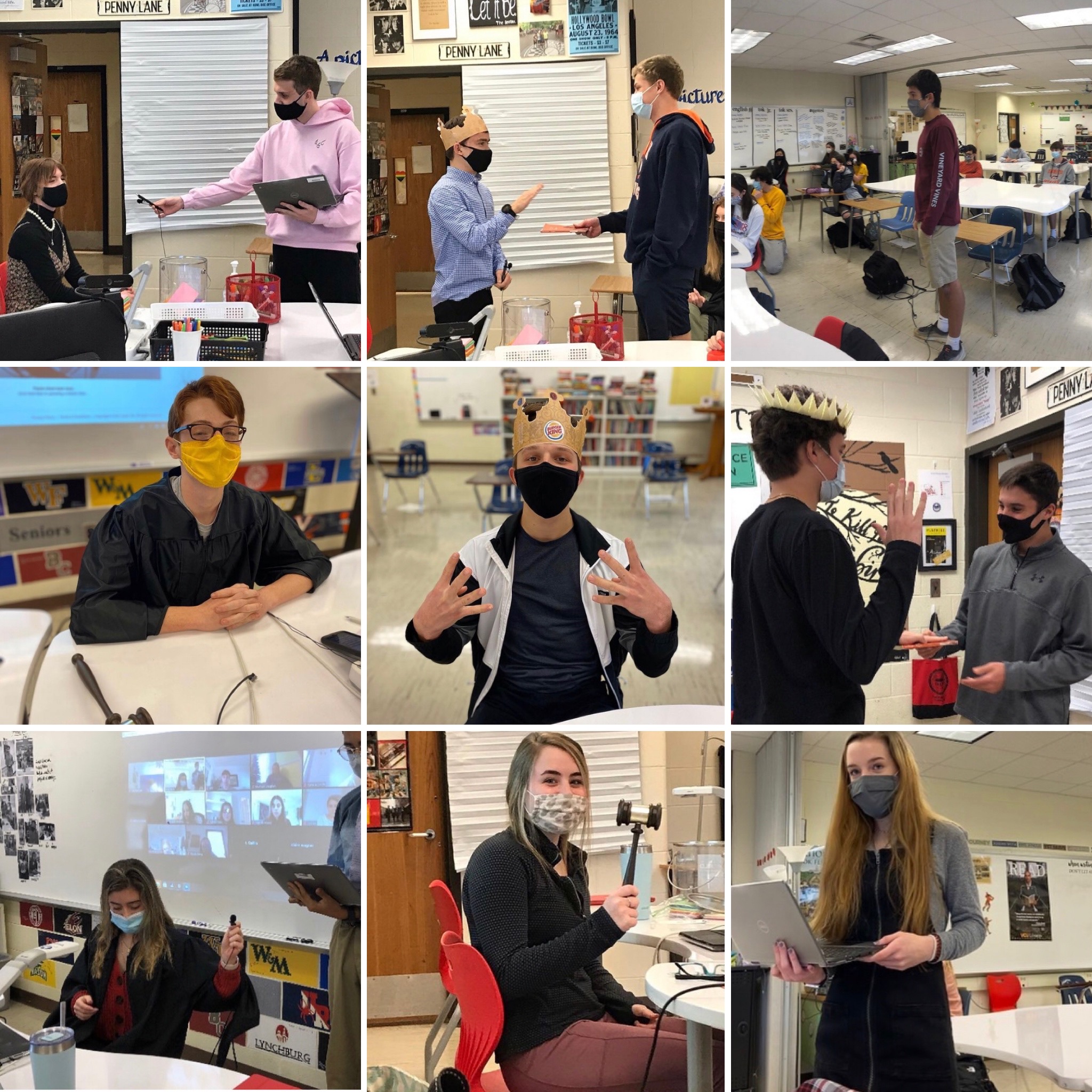
     The need to be validated in a pandemic--whether we're teaching or learning  in it--is so necessary. We need to continue to build each other up; learning in a pandemic is just as hard as teaching in one. So, I want to end by validating you, my students. To the juniors, you made me most proud recently in your mock trial. Instead of saying that we couldn't do an assignment like this, you embraced it. So, when it came time to put Antigone on trial in our classroom, you made it happen whether you were an attorney virtually arguing your case on zoom or the bailiff swearing everyone in by emphasizing the word "truth." You brought levity to an intense book while simultaneously showing me learning could be fun--even in a pandemic. 


      And to my seniors, I think sometimes I forget how much you've lost--no spring sports last year, no junior prom, not a single senior pep rally, no senior section of the rage cage. I know sometimes I can be critical of your decreasing motivation otherwise known as "senioritis," but you have shown me so much grit and perseverance--more than any other class. You are making the best of a difficult situation. You've had the glass of water thrown in your face, but it doesn't matter. You're overcoming and surviving and succeeding and persevering. For that, I see you. I hear you. I validate you.

     Know that I intend to make changes in my classroom. After all, I sought feedback so that I could do just that. Honesty is a good thing even if it sometimes is hard to swallow. Yet, everyone also deserves to be validated. So, the next time you find someone else up against gravity, ask yourself what you can do to validate their feelings. The next time you go to throw that glass of water in the face of another, ask yourself if you are seeking validation for yourself for the right reasons. What I've learned recently from all of you is the value of honesty combined with validation is a beautiful thing. We may be up against gravity in this pandemic, but remember, we are never, ever alone.

Thursday, December 31, 2020

The Best Is Yet To Come: My Word for 2021

     I have come to value the moments of beautiful irony in my life--not the moments that Alanis Morissette referenced in her hit song in the late nineties, but those moments whose hands are gripped tightly around me, trying to destroy everything in sight yet eventually make me stronger, happier, more resilient in life. When I was 23 years old during my second year of teaching, one such moment occurred; I was asked by my first principal, Mr. John McGinty, to coach the high school debate team.

    "Mr. McGinty, I know nothing about debate. I don't even like to argue." I found myself trying to find a reason or a way out while simultaneously desiring to make him proud.
  
  "You'll be great," he said, with the infamous twinkle in his eye and smile on his face that he constantly wore. As an eternal optimist, he really believed that; I, however, could only see the irony of it all: I am the peacemaker, the person who never takes a side and who was now going to spend hours after school with students who actually enjoyed disagreement. I agreed to Mr. McGinty's request because I respected him and didn't want to let him down, because it was easier to just say yes. I taught during the day, coached track after school, and then several times a week in the early evenings, I would meet with the debate team. I learned a lot about argument, too much about my weaknesses, and a great deal about being patient with teenagers who thought they knew everything (Truth be told, the members of that team did know a lot--definitely a lot more about debate than I did).

     Ultimately, this was a moment of beautiful irony. You see, I met my husband Chris through coaching debate. He coached at a neighboring school, and we started talking at a VHSL rules clinic for debate coaches early on in the year. At the time when Chris offered me a Sprite from the hospitality table, I had no idea that he actually was flirting with me. After all, who goes to a VHSL rules clinic for debate coaches to meet someone, especially the person you plan to spend the rest of your life with? Yet, that year as we spent many Saturdays together at debate tournaments, we got to know each other, and eventually, we began dating. Almost twenty years of marriage later, the rest is history and goes down as a moment of beautiful irony. 

    These moments of beautiful irony tend to creep up on us when we least expect them to. 2020 was no exception. Every year, I choose a word to serve as a goal for the new year. Last year, I chose the word "embrace" as my word of the year. Talk about moments of irony--I spent ten of the twelve months unable to embrace anyone due to Covid-19. Instead, I spent time disinfecting, wearing masks, and distancing six feet apart. I am a hugger. (I hate to argue, remember?)  I know many people struggling by the limitations of Covid-19; the hardest for me has been the lack of hugs. Yet, my word was not a complete failure despite its presumed irony. My goal last year was not just to physically embrace others but to embrace new situations. And that, I think, I actually did fulfill.

     Covid gave me a chance to reflect--a lot. Covid humbled me as a teacher. I don't know too many people who show up to work every day, working as hard as they can, even though they know that they are not going to do a good job or as good of a job as they do in a "normal" year. Teaching synchronously is definitely one of the hardest experiences I've had in teaching, but it's also humbling. I've tried new things this year from a basketball competition to eating outside with my students to embracing all sorts of microphones and video appearances. In my personal life, I've baked new recipes. I've run a half marathon virtually. I cut my son's hair (a never-again experience) and we've had a lot more family dinners. I'm not as afraid anymore to express what I think, especially in my writing. I've embraced a lot--we all have--and I'm stronger because of it. We all are. Talk about beautiful irony.

     So when I had to choose a word for this year, I was stumped. My word from last year--a seemingly epic failure of ironic proportions--actually became a way to live life. This year, I wanted a word that showed positivity and hope, one that would present a challenge for me and maybe a similar moment of beautiful irony. I went through words like rise, worth, shine, glitter, hope, grace, thrive, leap, smile, laugh, confidence, legacy, reach, but none seemed to be speaking out to me. So this year, I settled on "yet." You may be thinking, yet is hardly a word. Yes, this word is often overlooked, yet more frequently used than you think (See how I used it there?). Yet represents possibilities. Yet signifies eventually and at some future time. Yet means in addition. Yet changes a mindset. As a conjunction, yet blends sentences together to change the direction--to often create beautiful irony. 

    So for me, yet is the word I am embracing in 2021: 

     I haven't gotten a Covid-19 vaccine yet.
     Things may be challenging as a teacher, yet I am learning so much.
     I won't give up yet--on myself, on my students, on our society that is often plagued by polarized views.
     There are so many incredible moments--moments of beautiful irony--I have yet to see unless I allow myself to see them, allow myself to experience them, to laugh and grow with others.  
     
    I'm no longer a debate coach, yet I've learned to embrace some of the moments in life that might make me feel a little uncomfortable. Such moments have created a beautiful irony. I often think about what life would be like had I not said yes to Mr. McGinty's request to coach debate over twenty years ago. What a hand he indirectly has played in my life. What a moment of beautiful irony he created! (If I haven't said it yet, thank you, Mr. McGinty!)

     2020 brought us a world of frustration, of sorrow, a world without hugs and with a whole lot of distance. I miss my family and friends. I miss the casual smiles I see from strangers in the grocery store. I miss the hugs and high fives in my classroom. I've had friends and family who have struggled through this virus and some who are still struggling. Yet is the word that is going to pull us through in 2021. Yet is going to turn our "I can't" moments into "I can't yet.Yet is possibilities and growth. We may be struggling right now, however, the best is yet to come. And that, my friends, is beautiful irony.


Nine Photos to Capture 2020


Thursday, December 17, 2020

I Didn't Sign Up for This

I didn't sign up for this. 

     That's what keeps coming to mind this year every time I put on a mask before I head into a public place, every time I unsuccessfully search for Clorox wipes on the grocery store shelves, every time I clean the desks in between classes, every time I start a zoom during my face to face class, or I look into that zoom and there are many black boxes instead of smiling students, every time I look at the room as students are spread apart and limited by lack of high fives and hugs, every time I have to revamp a lesson plan because it just can't be done the way we used to do things, every time I am muted or just can't get the technology right, every time I sit down to grade a set of essays because I'm teaching more students than I ever have in my teaching career.

No, I didn't sign up for this. 

None of us did. But here we are in the middle of a pandemic--teaching and learning and existing as best we can, doing all the things we never signed up for.

     There have been many moments in my life that I remember saying, I didn't sign up for this. I'm in high school, and my school counselor asks me to sit with a student named Meg. Meg was a social outcast; people made fun of her on a regular basis, she didn't have the finest hygiene habits, and often acted like she had a chip on her shoulder. I abandoned my friends so Meg could have one, and all she did was smirk, move her chair further away from me, and take out a paperback book to read. I didn't sign up for this. 

I'm a new parent caught in traffic on the Verrazano Bridge headed to New York with just 9 month-old Maggie in the car, and I somehow manage to get the stomach virus. I finally get off the bridge and vomit on the side of the road as Maggie is screaming in the back seat. How can I be an effective parent when I can't even take care of myself? I didn't sign up for this.

     I'm a teacher at a new school--Benedictine High School, an all-boys, Catholic military school. I'm in the middle of my teaching career, but nothing could have prepared me for teaching in an all-boys classroom. The boys come bounding into my classroom that first day--full of energy, familiar, joking and laughing. They all look the same to me: tiny beady eyes, clean haircuts and upper lips, creased pants, and shiny shoes greet me. They stand at attention as I walk to the front of the room, their shoulders stiff, as if boards are lodged inside their backs. I start my introduction, and they still remain standing at attention. Finally, after what seemed like the longest two minutes of my life, one Cadet whispers I need to tell them to be "at ease" so they can sit down. I'm a young woman in an all-boys school that seems more like a cross between a fraternity house and a small army than a classroom. I didn't sign up for this.

     So, as 2020 comes to an end in a few weeks, I've been thinking about life as we know it--a life I never signed up for, anticipated, or desired. I am working harder than I have in my twenty-two years in the classroom. So are you, my students. Yet, what you've learned is far more than what I could teach you or what a textbook ever could. You've learned flexibility. You've learned perseverance. You've learned how to appreciate the little things. You've learned the value of time. And I, too, have learned much of the same thing because you have helped me forget what I never signed up for and see the good.

     Sadly, there's no "full disclosure" statement that comes with living in a pandemic. Actually, there's no "full disclosure" statement when it comes to life. While I wish that every possibility you may face could be common knowledge before you experience it, sometimes we are forced with the reality that we just didn't sign up for this. And maybe that's okay. In the past four months, I've watched you handle difficult situations. You've navigated school virtually, Some of you quarantined and still managed to keep up. I've watched you have things you love ripped away from you--sitting across from each other at lunch, athletic events, pep rallies, the Rage Cage, homecoming. 

     This past month, in our TOK Class, I've witnessed you make the holidays happen for over forty kids in the Hanover Preschool Initiative at Henry Clay Elementary School. Many of you bought these students--students you never even met--gifts, and we spent a class block wrapping them (some of you now have another new skill).

Shopping for presents


A socially distant sword fight after wrapping

 I've watched you attempt new ways of writing and embrace everything I've thrown at you in the classroom--including playing basketball with a paper ball and even a John Lennon parody karaoke competition (my way of putting that big microphone in my room to good use).


You've helped me troubleshoot the best ways to teach synchronously. And when the internet went out this week, I watched you help me figure it all out because I didn't want to lose a moment of instruction.

     I've found myself becoming more and more reflective during this pandemic. For someone who naturally reflects on just about every moment of her daily life, that's a lot of reflecting. Yet, what I've thought about is sometimes the things we didn't sign up for, the things we are somehow "voluntold" to do, are the things where we learn from the most. Take that moment in high school when I had to sit with Meg, for example. I sat with her for a week straight, and she continued to smirk and read her book--until one day when she smiled. I got Meg to smile. That's what I'll remember.

     And I think about that moment being sick on the Verrazano Bridge. After finally reaching my destination, my daughter got to meet her great grandfather for the first time. I think that's more of what I will always remember than the fact that I was sick on that bridge. 

  And I think my years at Benedictine were the first years where I realized as a teacher that I can learn from my students.  Those boys taught me more about the kind of teacher that I wanted to be and made me a teacher I never thought I could be because they allowed me to fail, get back up, and try again. That's what I will remember.

We may not have signed up for any of this; life is hard; being an educator is hard; being a student in a pandemic is harder. So, as you come to the end of this year--a year where you wanted to shout from the rooftops, I didn't sign up for this--think about how you've grown, how you've changed, how far you've come. The sign up sheet may be long of things you never intentionally signed up for, but its rewards might be longer if we allow ourselves to see them.

Sunday, November 8, 2020

Thoughts from the Chick-fil-A Drive Thru

       I rolled through the Chick-fil-A drive thru with tears in my eyes. The parking lot was crowded, but I knew from my students who work there that the line would move fast, and that once I paid for my food, I'd have it in five minutes with a "My pleasure" to follow. It was around 5:45 p.m., and I hadn't been home yet, staying after school for not one but two meetings--both virtual. I felt broken after teaching that day, thinking the day could have been better spent in bed in my pajamas. With no lesson plans done for the next day, I was entirely overwhelmed and did not think I could continue to teach in this pandemic. Unsustainable has been a word I often use to describe what I'm doing this school year, and I had just used that word to describe my experience in my last zoom meeting. Rarely am I negative, but as I pulled into Chick-fil-A, I was angry and frustrated and even hard on myself for not having the energy to cook dinner for my family. I composed myself, rolled down my window, and placed my order, but when I went to pay, I realized my purse was in my trunk. I proceeded to hold up the entire line in rush hour to retrieve my purse to pay for my food, and it was then as I got out of my car, I saw one of my students in the line next to me waving. Actually, her entire family was waving and saying hello. She was a reminder of why I do what I do. She was a reminder that I need to show myself forgiveness and not put so much pressure on myself, not worry about whether or not I am cut out to teach in a pandemic. After all, school is not about being the perfect teacher or even a good teacher. It's about building relationships with students and a classroom community. It's about helping one another in a world where sometimes everyone seems to be forging his own path.

     These days I feel like we place an inordinate amount of pressure on ourselves. There are social pressures of what others think. As a student, there's the pressure to earn good grades or do the right thing or be in an excessive amount of clubs and organizations. There's the pressure to get into college and be the best athletes, citizens, children, students, people we can. There's pressure from our social media feeds to the clothes we wear. Why do we have this internal clock that makes us think we constantly have to be working to be better than everyone else?  We compare ourselves to others on who has it harder, easier, who is smarter, funnier. Your uphill climb both ways in the snow will always outdo mine.  What if we stopped putting this pressure on others and ourselves?  What if we started rooting hard for each other instead of pulling each other down?   

      In 1993, George H.W. Bush wrote a letter to Bill Clinton when Clinton won the presidential election.  The letter talked about the office of the presidency, and Bush ended the letter to Clinton saying, "I'm rooting hard for you."   

 Every time I read that, I'm in awe at President Bush's words. Here were two political rivals who put aside differences to see the common good and encourage one another. I think that's something we need right now--encouragement. We need to be lifting each other up instead of pressuring one another on who's the funniest, the smartest, the most popular, the best athlete, the fastest. I have met people who often try to "one up" me. My hardest moment is never as hard as theirs. My greatest success can never compare to theirs. Let's stop doing that. Let's root hard for each other.

        So, here's what I'm rooting for: I'm rooting for you, my students. You are the 140 individuals who have shown me far more grit and resilience in this pandemic than any other group. You are the people I spend more time with on a daily basis. You are the people who never seem to complain, who keep going. Yet, I also see your stress. I also see the pressure you put on yourself to be the best or better than others. I see the pressure inside of you--even if you aren't competing with one another. It's easier said than done, but I think when we stop worrying about how we will succeed and start cheering each other on, some of that pressure is relieved. More importantly, some of that support of others is simply necessary while living in a pandemic.

     What I've learned from teaching in this pandemic is teachers and students are more united than they were before. We are in the trenches together--whether that be face to face struggling through the forward-facing rows and one-way hallways or whether that be on zoom as we long for far more of a connection than a screen. There's a level of grace this year that exists between teachers and students that I'm not so sure existed before--or at least I like to think so. In many years a disconnect can occur between teachers and students. What if I told you this year, I feel like we are on the same playing field? It's hard to teach in a pandemic; it's equally hard it learn in one. There's nothing easy about it so instead of putting pressure to be the people we were before this virus, what if we just gave ourselves and each other grace? What if we rooted for one another?  I see you, my students, constantly rooting hard for me--whether that be just checking on how my day is or helping me navigate three screens of technology or bringing me chocolate to get through the day.

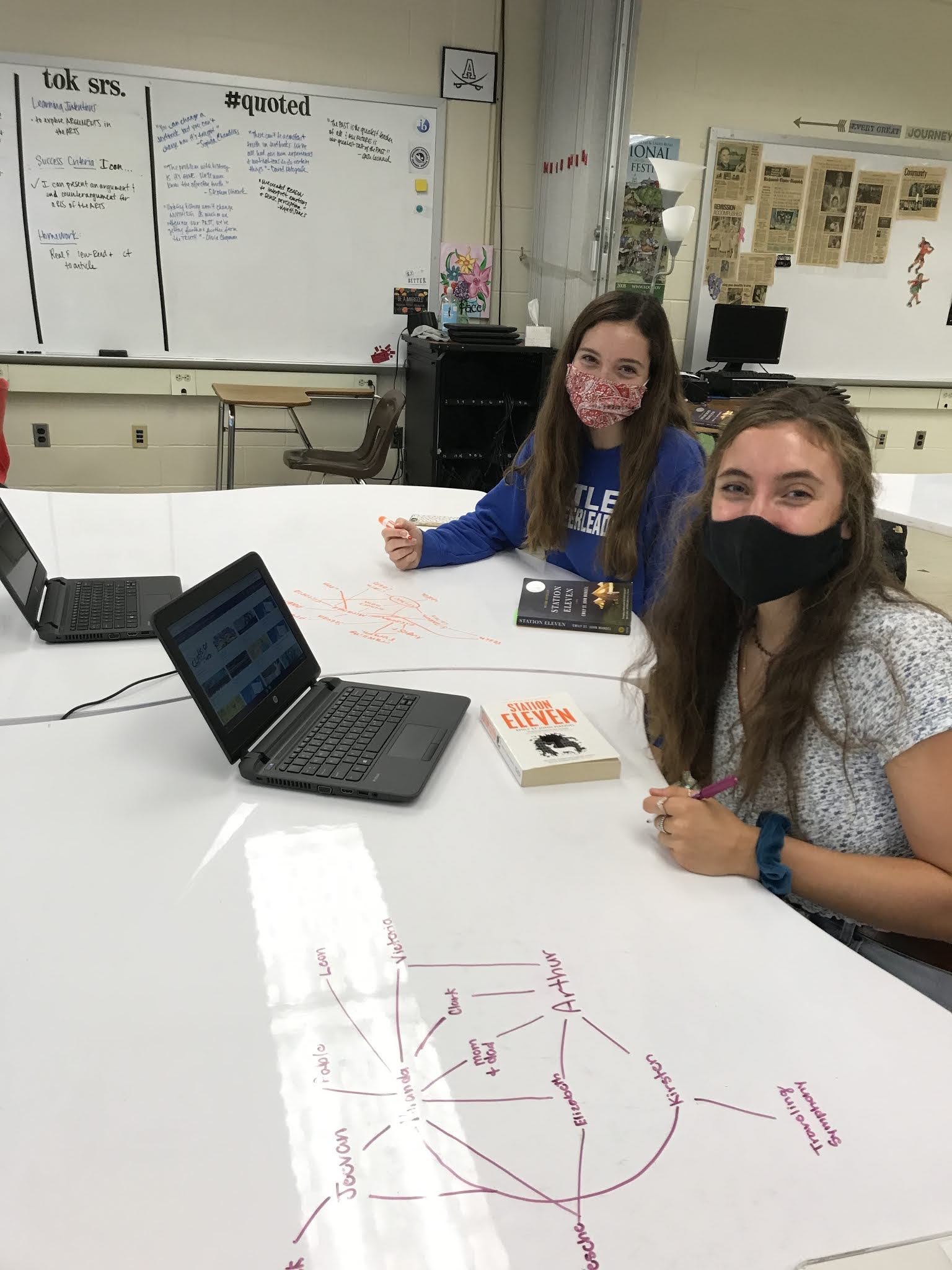
     Likewise, I rooted for you quite often this past month. IB English students, you drafted and recorded podcasts about your Covid-19 experiences. They sounded so professional that my own children at home asked me what I was listening to. Perhaps one day you will look back and listen to your own experiences with pride of the resilience and grace you exhibited in living in a pandemic. I also witnessed you thinking outside the box in your analysis of Station Eleven. Perhaps I was cruel to ask you to read a book about a pandemic while we are living in one, but you never faltered or complained. Because this book is one without many teacher resources, most of the conversations and activities we've done with it have been from my own thinking. It's allowed all of us to think outside of the box and demonstrate far more creativity. I'm proud of the work you did. 


Six Degrees of Station Eleven projects

     And my TOK students, you set up and opened a mental health space for the entire school to use. You put ideas and research into this and despite the fact that we do not have goats or a bird bath like you asked for, you made this space a place for others to take a break. 


Raider Retreat Ribbon Cutting Ceremony

Seniors, you've done what I believe all good classrooms should do--you took time to know each other. While you may have spent up to twelve years in school together and were actually all together in TOK last year, you started having conversations with others in our classroom you don't regularly talk to. You resolved conflicts with one another. Yes, you have had some interesting discussions about the arts as an area of knowledge, but you've also gone beyond the curriculum to support one another. I hope you continue to do that.

"Family" Breakfast


     At the end of the day, if you can remember one thing in the middle of this pandemic, it's this: I'm rooting  hard for you. 

     So, promise me you'll stop putting pressure on yourselves and on each other. And I promise you I'll stop putting pressure on myself to be the teacher I was last year or to make you the perfect students. Remember, sometimes it's okay not to be okay. Sometimes it's okay to just go through the Chick-fil-A drive thru because like me, your moment of clarity  might be waiting for you there. And when you do have a day where you just want to put on pajamas and crawl back into bed, know I'll be rooting hard for you--always.