Saturday, July 27, 2019

The Life In My Head: Me, Unfiltered

   For over a quarter of a century, I have been running in order to think. That's over twenty-five years of thoughts from why does my teacher always call on me when I don't know the answer to why does the thumbs up emoji annoy me to why people are so obsessed with the aging face app (I already can see the aging process thanks to a certain ten year old I know) to how am I going to be better today than I was yesterday?   I often surprise people when I tell them that I am an introvert and live a lot of my life in my own head. Running has always helped me process things, plan my favorite lessons, make decisions, figure out my parenting shortcomings, and tear down walls that I tend to put up for myself. In other words, running enables me to survive the life I'm living in my head. While I have run with others and enjoy the company, most of my runs are done solo--just me, my music, and the pavement. I don't have expensive running shoes and tend to wear a t-shirt and shorts--no fancy running gear.  As I've gotten older, I don't care so much about how fast I run or if I have to stop and walk a steep hill because my achilles is hurting again. I don't run to train for any kind of race. I've run a marathon and two half marathons; to me, those are accomplishments of a previous lifetime. Running is me in my simplest form--real. unfiltered, vulnerable.

      Recently, I've been thinking about how we need to stop filtering our lives. Filters are everywhere--Snapchat, Instagram, on what we say; even some of the air we breathe is filtered. We tend to put up walls in our lives instead of letting people in. How often do we not show the real "us" but the person we would like to be or the person we would like others to see us as. I roll my eyes at my son's desire to gain 100 subscribers for his YouTube channel, but I will say he completely puts himself out there every time he makes a new video. He's not afraid to show others what he's passionate about; there's something to be said for that.  He is real and authentic in every video. I've been trying to be conscious of the times I am unauthentic and find ways to be real and unfiltered. As I've attempted to do so, this idea of authenticity and living an unfiltered life keeps surfacing.

   This past week, I spent watching my kids play on the beach.  They started to build a sand castle that they wanted to protect from the waves. Building a wall around the castle, they attempted to protect their creation until my husband suggested that they needed a tunnel to let some water in. As they tore down part of the wall, I began to think again about this idea of being vulnerable. That tunnel became a metaphor for what I think our society needs--truth, honesty, vulnerability--an unfiltered world that lets the water in every now and then.

       I also recently went to New York City with one purpose in mind--to see To Kill a Mockingbird  on Broadway. My husband and I had tickets since November. When we got in line to see the show about forty minutes prior, the lights went out in the Broadway area. Twenty minutes later, they cancelled the show, offering us a refund. I was devastated; I wanted to see my favorite book come to life on a Broadway stage. Before I could grapple with the idea that I may not see the show, I had to navigate out of New York City. Yet how do you do that when there are no traffic lights, entire city blocks are shut down, and people are moving shoulder to shoulder throughout the streets? This was New York City unfiltered. I marveled at how everyday civilians directed traffic so that cars weren't dodging one another. New York continued to function--naked, without traffic lights and Times Square lighting up the night--an unfiltered city that when faced with adversity was able to thrive.


New York in darkness


     One of the books I read this summer was Be Real by educator Tara Martin. In it, she explains what it means to be REAL in the classroom--to be relatable, expose vulnerability by sharing experiences, be approachable, and learn through life. What simple but perfect advice. This is the goal I will continue to have as I begin the school year in a few weeks; it also is how I will continue to live my life--real, genuine, unfiltered.                                                               

     I've learned from my runs I am far from perfect. At times, I'm a true parent catastrophe. Other times as a teacher, I fail to connect with my students even though I always want to. Sometimes I'm afraid to tell others how I really feel. My goal this summer has been to be more authentic, to be real. And that's what I want to encourage you to be as well. To my students returning to school in a little over a month, remember that you are not perfect; no one is. Don't be afraid to make mistakes. Show the real, authentic you as you do so. To the students I taught from the Class of 2019, you head to college in a few short weeks. Some of you may be completely excited to enter a world of freedom. Others may be scared to be on your own. Whatever you are feeling right now, let yourself feel it. It's okay to feel the way you do. You will find your ground, and when you do, what an impact you will make!

     As for me, for now, I'll keep running and working through the things in my head. I'll keep wondering why my kids won't stop listening to the song "Old Town Road" and why they desperately want to figure out if water is really wet (sadly, that was a lengthy debate in our house recently). I'll continue to wonder how I can make an impact on those I meet in a real, authentic way. I'll take the filters off the pictures and live my best authentic life--just me, my music, and the pavement. Right now, I can't imagine it any other way.

Friday, June 28, 2019

Sitting on the Metaphorical Shelf: My Experience Reading Harry Potter

     Over fifteen years ago, in 2003, my father-in-law, Jay Pace, put a copy of Harry Potter and the Sorcerer's Stone in my hands. "Read this," he said. "I don't usually like this kind of book, but it was really entertaining." I put it aside, thinking I would, perhaps, read it at some point. J.K. Rowling published the book in 1997, the year I graduated from college and started teaching. That year, I confess, I was just trying to keep my head above water in my classroom. I read only the books I was teaching; that's really all I had time for after staying up long hours writing lesson plans, grading papers, and learning the art of adulting.  I remember students racing to read the series once it became an international sensation, but it didn't seem to captivate my attention. Even when my father-in-law--someone I respected as a person and a writer in his own merit--placed the book in my hands, I struggled to crack it open. In 2004, my father-in-law passed away unexpectedly, a year after he lent me the book. I still hadn't read it and just couldn't seem to bring myself to do so.
Image result for jay pace
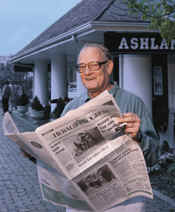
Jay Pace, my father-in-law, posing with The Herald Progress at the Ashland train station
       I always imagined I would read the Harry Potter series with my kids. Somehow, though, we never did; like me, they were never interested in the books. I watched as their friends dove into the culture and magic of Harry Potter. I took my kids to birthday parties bearing the theme, and so many of their friends have worn Harry Potter Halloween costumes. And yet, I still hadn't picked up the book. Over the years, I've had students marvel that I was an English teacher and hadn't read those books. "I just don't like that kind of book," I would tell them. I've had students who were required to read J.K. Rowling's work in college classes. One student even wrote her extended essay--a 1600 word essay students are required to write if they are pursuing the IB diploma--on Harry Potter and Shakespeare. I was intrigued by the topic, but I still hadn't picked up the book. At an elementary school book fair this winter, my son's principal approached me, also amazed that I hadn't read Harry Potter. After her encouragement, I bought Jack his own copy, and we were going to read it together. Yet, I never picked up the book; neither did my son.

      I'm not sure what made me make excuses for not reading Harry Potter for so long. Perhaps it was too mainstream. Perhaps it was knowing I wouldn't like it because I tend to like more realistic fiction. Perhaps it was the fact that if I read the first one, I would be committed to reading the entire series. Perhaps it was because it would make me remember my father-in-law, wishing he was here so that I could have discussed the book with him. Whatever it was, those excuses evaporated this year, as I found myself making a promise to one student I taught that I would read the book. I volunteered to supervise the Atlee Book Club this year, and the books they had selected for the final meeting were all books that I had read. "You could read Harry Potter, Mrs. Pace!" one of my students said, smiling. I didn't know how to tell her that I was scared to read that book--that I thought it would be too hard  personally. So, I smiled and told her I would. At her graduation I told her I had read three--no, not three of the books in the series--three chapters. I had started and made a promise to really read it over the summer and to give her a report.

     Like most English teachers, I have a pile of books to read this summer; I adore the unencumbered time this part of the year affords me to read. Harry Potter was carefully placed at the bottom of the stack--until I saw Toy Story 4. I promise not to give any spoilers to the movie in case you will go see it, but there was a line in that movie that stopped me in my tracks: "If you sit on a shelf the rest of your life, you'll never find out." Woody says this in the movie to one of the toys, encouraging her to take action. For fifteen years, I had left Harry Potter on both the literal and metaphorical shelf. I didn't know what I was missing. So, that afternoon, I stopped sitting on the shelf, moved Harry Potter to the top of my pile, and started reading.

     I learned much from reading Harry Potter this first week of summer. For one, I learned that I actually like the book. Dumbledore was the character who I admired most because of his sensibility and wisdom. I loved that  Hermione seemed so real because she was a rules follower who occasionally didn't follow the rules and found Harry to be an innately humble hero. Towards the end of the book, Dumbledore states, "It does not do to dwell on dreams and forget to live" (Rowling 214). I marveled at how much that sentence resonates with the line from Toy Story 4. Suddenly, Harry Potter motivated me in ways I never thought it would.

     I will admit, I still don't love the fantasy genre as a whole, but what I got out of reading Harry Potter was far more important. I learned that I can't make excuses for things that might seem difficult or out of reach. I can't put things off for a future date. I can't dream of what I want my life to be like; I've got to take action. I can't sit on the shelf for the rest of my life. When my father-in-law was living, he was the editor of the Herald Progress, a community newspaper that served much of Hanover County. A few times, Jay asked me to write an editorial for him. I was scared to do it in much the same way that I was scared to read Harry Potter after he died. I never did write for him. He would have loved the blog I started writing three years ago, though. This summer, I encourage you to do one thing that you've been putting off. Let if shift your perspective or change you positively. Let it help you grow as a person.

      Sadly, I never got to discuss  Harry Potter with my father-in-law, but I now know that's okay. For had I read this book when he asked me to read it, I most certainly would not have gained this perspective. I think I still might be sitting on that metaphorical shelf, forgetting to live--and what a rather unfortunate life that would be.


Sunday, June 2, 2019

A Yellow Brick Road Farewell

     When I was in high school, I was in the play The Wizard of Oz. While I aspired to be the Wicked Witch of the West and thought I had her cackle down, apparently according to the director, I wasn't "mean" enough. Instead, I landed the part of the munchkin (more than likely, my height helped me acquire this role). I learned to dance on my knees and even acquired a munchkin voice that comes in handy when I want to make my kids laugh or I need a random fun fact about myself in social situations. As a munchkin in Oz, I learned every single line of the play. I'm not sure why; if the Wicked Witch of the West got sick, I doubt they'd ever put me in. Still, to this day when The Wizard of Oz comes on t.v., I know the lines. When my father-in-law was alive, he could recite the movie as well. I remember when we discovered that we had this in common. We were watching the movie in the Outer Banks over Thanksgiving break. Finally, someone existed who wasn't annoyed that I could sing every note of the scarecrow's ballad of desiring a brain or talk like the Cowardly Lion, lamenting he was not king of the forest. There's one scene in particular that I always am drawn to, though--when Dorothy has to say goodbye to the Tin Man, the Scarecrow, and the Lion. The dialogue goes like this:


Dorothy: Goodbye, Tin Man. Oh, don't cry! You'll rust so dreadfully. Here's your oil can.
Tin Man: Now I know I've got a heart, 'cause it's breaking...
Dorothy: Goodbye, Lion. I know it isn't right, but I'm going to miss the way you used to holler for help before you found your courage.
Cowardly Lion: I never would've found it if it hadn't been for you...
Dorothy[to Scarecrow] I think I'm going to miss you most of all.

This scene sums up everything perfectly for me right now. My heart breaks to have to say goodbye to my students at the end of the school year. 

     I think about all of the goodbyes I've experienced in life--transitioning from a flip phone to a smart phone, saying goodbye to the mini van with too many miles on it. I've moved out of houses and said goodbye to friends who moved away. When I was thirteen, I let balloons go into the sky outside of my grandmother's hospital room--orbs of blue and yellow and pink floating among the clouds--as we prepared to say goodbye to her. I've shed pounds (unfortunately, only to welcome new ones back). I cry every time I back out of my parents' driveway, knowing I won't see them again for a few months. I've had to say goodbye to book characters who became my "friends" as I was reading and tv shows like Friends that were a staple in my high school and college days (thank goodness for Netflix). I know goodbyes are inevitable, but why does it take a brief moment to say hello and forever to say goodbye? Why are goodbyes so hard? This week, I will have to say goodbye to you, my students. While some of you I will be fortunate to have in Theory of Knowledge next year, many of you will never sit in my class again. Seniors, I'm not going to see you in the hallways on a daily basis. You're not going to put up with my memes There's no more tardy table and bells and elbowing crowded hallways. There's no more "us" as a class.

     The question I've been most asked by most people I've encountered recently is "You're a teacher; you must be ready for summer?" And while I need a break from essay grading, I have always had a hard time at the end of the year. Most people shake their head or laugh when I say this. I've even encountered a few eye rolls. 

Yet, I'm saying goodbye to so much:

one of the captains of the football team and several lacrosse players with some interesting new hairstyles.

the Editor-in-Chief and Photography Editor of the yearbook and some other yearbook staff members.

 a student venturing to Japan for college even though he doesn't speak Japanese (I have no doubt he'll be fluent shortly, though).

the creators of the Raider Readers book club and 9 of the top 10 ranked for their academics.

students passionate about politics.

a student who started a Special Olympics tennis league from the ground up.

a fearless jazzercise leader and two students who brought yoga to a local elementary school's field day.

a student who grades my memes regularly--and who has taught me so much (about meme making and life).

someone who taught inner city kids how to swim and provided them with swimsuits and goggles so they could do so.

one of the best drum majors and constant advocates of positivity.

a leader in the FFA.

a student who can construct a paper airplane far better than I can and another who is an expert at going on tangents.

a student with more nicknames than I can count on my fingers,and a gymnast who can far out flip anyone I know even when she's injured.

students who have mastered the water bottle flip, the marker flip, and even created a new system of math.


The Class of 2019


I say goodbye to 

readers and writers and also the students who read the Spark notes instead of the books.

students who are doing wonders for the Speak Up Club.

a bunch of show choir kids who have broken out in song in my first block class more than once.

 students who have taught me about texting shortcuts (fr). 

students who can banter beautifully about Classic rock.

I say goodbye to an EMT.

someone who successfully hijacked two powerpoints and who also made me my very own pair of shoes.

actors who light up the stage in theatre productions and improv.

table artists who leave me daily positive messages.

I say goodbye to 28 seniors, 86 juniors--114 people who have become my family. These are the people who have seen me at my best in the classroom but have also seen me at my worst and still accept me for the teacher I am. These are the leaders and athletes and artists and cultivators of kindness of Atlee High School. I say goodbye to people who inspire me to be better--1% better than the day before. I say goodbye to intelligent, strong, compassionate young people who I have been so lucky to teach.

Goodbyes are not easy. No one ever said they were. In one week, I will have completed 20 years of teaching. 20 years of hoping I made a difference. 20 years of faculty meetings, papers graded and relationships built. 20 years of saying goodbye.

In having to say goodbye, my heart breaks like the tin man.

Like the lion, you no longer need my help; you have the courage to move on.

And just as Dorothy returned to Kansas, I'll return to my classroom and shut the door when the last of my students leaves for the year. While I know there's no place like home, I also know the Class of 2019 will always be my scarecrow: I think I will miss you most of all. 

Juniors, make your senior year the best it can possibly be. Don't become complacent or give up too early. You are capable of such great things.

Class of 2019, go out and make a difference in this world as you have in my life. And know that it's hard to say goodbye because I love teaching you; I always will.


Monday, May 6, 2019

This Month's Sales Report: What's Most Important in Education

     "I should be in sales," I say jokingly.

      I often find myself uttering that statement to people I don't know when they ask me what I do for a living. As an English teacher, I sell books every day to students who have no desire to read them. The job is far from easy. Do you know how difficult it is to get my students to like Mary Shelley's Frankenstein or get them to read "for fun?" I'm realistic to know that some of you would say that I didn't succeed at either of those things this year nor any of the twenty years I've been in the classroom. When I first became a teacher, I thought that you, my students, would hang on to my every word. I thought you would come to class having read every book and be inspired by the assignments I asked you to write. But just because I enjoy being at school and haven't left it since my kindergarten journey began in 1980, (that's 37 first days of school, by the way) doesn't mean you, my clients, are enthralled by my English class.

     Years ago, I took it personally when I found out students didn't read what I assigned. That moment could have put an end to my sales career. In twenty years of teaching, I will be the first to admit my sales reports are not always glowing. I don't receive a monthly bonus for the books I do get you to read, but I continue to sell books because it's what I love to do. As students, you have become my clients and have challenged me in the best possible way every single day. Many of you want to take the shortest route to learning and earning that A. You live in a world that forces you to be driven by social media, where you abbreviate even the abbreviations, speak in memes I don't understand, and have phrases that read like a foreign language to me. You find it more convenient to write in terms of 140 characters as opposed to full blown literary analysis essays. My sales job of making English relevant and enjoyable is challenging when it's far more economical for you to watch the movie or read Spark Notes. Many in society would claim you, my teenage clients, are lazy, addicted to taking selfies, have no idea what REAL music is, and are self-absorbed. But you are growing up in a world that is so much more incredibly difficult than the teenage world in which I grew up. You have to decipher between real and fake news as massive amounts of information lie at your fingertips. You take the most challenging courses, complete hours of community service, play 2.5 sports along with 27 other activities, do hours of homework all to hopefully get into the "right" college. You have so many more pressures placed upon you by the same society who wants to call you lazy and self-absorbed.

     So if you happen to find yourself living in a world where you experience that pressure, I want to remind you of something today. I want to remind all of those adults who are quick to criticize teenagers of something to day as well. And if you can choose to listen to one lesson of mine, this is the lesson I want you to hear: Your grades are important. Working hard is important. Being involved is important. But so is being kind and compassionate. So is making a difference in the lives of others.

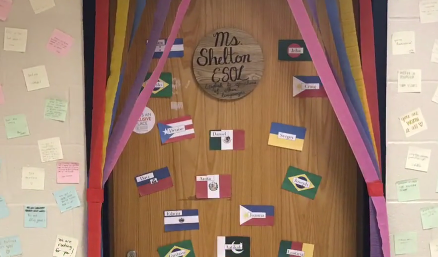
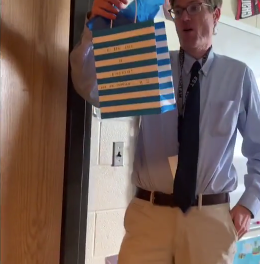
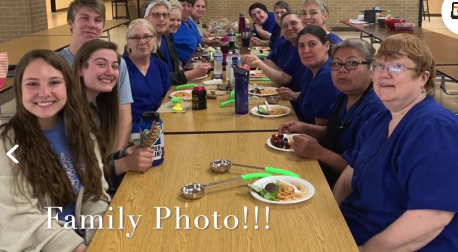
     This past month in my Theory of Knowledge class, Mrs. Leise and I challenged you to the Kindness Games--an opportunity to perform an act of kindness for a group at Atlee. I had no real expectations of how the assignment would go. Honestly, I thought you would perform your act, and we would continue with class, but this one activity stopped me in my tracks. Juniors created such projects as hosting a field day for the intellectually disabled students, honoring the music department with chocolate and notes of kindness, bringing the librarians a basket of treats, honoring Atlee's administrators, serving breakfast for the special education teachers, cleaning lab equipment for the science teachers, talking to a group of sophomores about IB classes, showing admiration to the PE teachers with a special video, and surprising the school counselors. Some of the senior projects included serving lunch for the cafeteria staff, writing notes of encouragement to the English Language Learners, making cultural desserts for the foreign language teachers, leaving notes of thanks for the maintenance staff, stocking the IB office with mints and other supplies for IB exams, baking cookies for your teachers, delivering bags of thank you notes to the history teachers, and giving dry erase markers to some of the members of the math department.


What happened when you did those acts of kindness on the day of the Kindness Games was a moment as a teacher I will never forget. You put genuine thought into your project, and in doing so, you surprised many people. You even made some cry. 

     We narrowed down the field to the final four and then to two final projects. We were honored to have Tamara Letter, a true ambassador of kindness who recently published her kindness journey in a book entitled A Passion for Kindness, as the judge for the final round of the competition.
Image result for tamara letter and a passion for kindness
Tamara Letter and her inspiring book, A Passion for Kindness

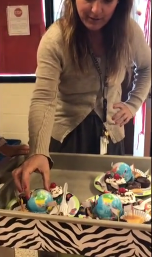
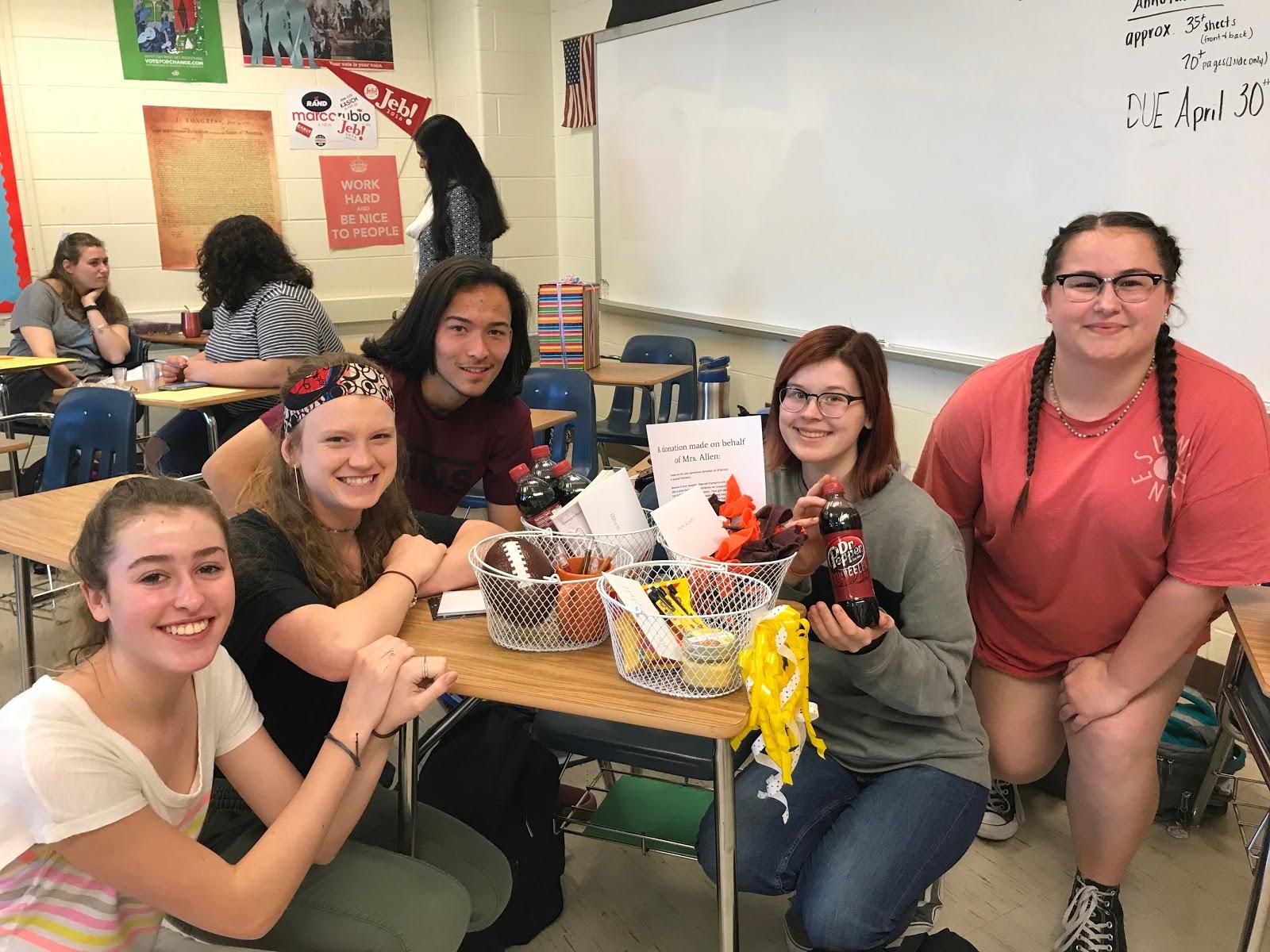
The winner of our Kindness Games was a group of juniors who presented a basket with specific, meaningful things to each administrator at Atlee. Dr. Wheeler received Carolina blue cupcakes and Dr. Pepper. Mr. Just received a football. Mrs. Campbell received a box of yellow items to radiate happiness, and Mrs. Allen received a donation in her name to the Special Olympics, an organization close to her heart. To see the video of the Kindness Games Champions' project, click this link.

2019 Kindness Day Champions

     As a teacher watching all of this unfold, I was blown away by the fact that you would come up with such meaningful projects. My only instructions were to perform and record an act of kindness. Mrs. Leise and I gave you no other guidance; there were no mini lessons or models to follow. Yet, I was the one who learned, perhaps, the biggest lesson. You might not want to read all of the books nor may you be enthralled by my every word, but you showed seventeen different groups on Atlee's campus that you are far from the self-absorbed, phone-loving teenagers that people set you out to be. You showed me how far kindness can go in a world that unfortunately stresses the value of intelligence and success over being kind.

     One of my first parent/teacher conferences as a parent proved to me an unfortunate event is happening in our education system. The teacher and I made small talk for a few minutes, and then she got down to business. She talked about my daughter's grades. My daughter did not have an A in everything that quarter, and the teacher sheepishly explained why, thinking that's why I was there. I wanted to know something far more important. "What kind of person is she?" I asked the teacher. The teacher stared at me blankly for a few minutes before responding. In the silence, I clarified my question. "Is she kind to other students? Does she make a difference in your classroom?" The teacher answered my question and then told me she never had a parent ask a question like that in her years of teaching; everyone always focused on the grade or the learning, not the soft skills like compassion and kindness. I guess I think this is where we've gone wrong in education. Success should not be measured by a GPA alone or how many activities you can manage to add before your resume topples over. Success should be the measure of the kind of person you become. When I first started teaching, I used to be a teacher who cared far more about the numbers--the grades in the grade book. I didn't see the bigger picture--what my students had learned and how they had grown.

     I realize now that no matter how much the world might seem to be about something else, kindness and compassion are what change it for the better. Of course, I'm still not going to give up on my sales job. Next year's students will read Frankenstein, and I will try my hardest to make a book written in the 1800's interesting and relevant. And I'm sure my sales report will come up short. Regardless, I will continue to acknowledge the world we live in is drastically different from the world in which I grew up. I will continue to remember that I am teaching students who will be in careers that don't even exist yet. (That concept is mind blowing to me sometimes). But I also will continue to teach kindness and be inspired by the teenagers I teach. Even when the world lets me down by misunderstanding them, I will remember these seventeen acts of kindness, smile, and be proud that my sales job introduced me to these clients.

Saturday, April 6, 2019

The Big Dance in Room 211

     I have always liked learning about the origins of words and ideas, so as basketball season comes to an end, I did a little research recently on the term "the Big Dance." In 1977, Marquette's basketball coach, Al McGuire, wore a bright blue suit to many of the games. A reporter asked him if he would wear that same suit during the NCAA tournament. "Absolutely. You gotta wear the blue blazer when you go to the big dance," he said. That year, Marquette won the NCAA championship, and the term "the Big Dance" somehow stuck.  I don't know much about Al McGuire, but I know he was extremely forward in his thinking. And I like the way he thought in metaphors.
Al McGuire winning the 1977 basketball championship
 
The 1977 Marquette NCAA Championship Team
     Continuing with this dance metaphor, I've seen leaders in all different capacities in my life, particularly on the dance floor. I'll never forget the dance I had with my dad on my wedding day. As the music started, he led me onto the dance floor and quietly began to talk to me. He told me stories from every stage of my life, arriving at the present day when the song ended. I laughed and smiled and cried as he talked. It's a moment I will never forget. How lucky I was to have him as a dance partner in that moment.
My dad and I on my wedding day
In my four decades on this Earth, I've had my fair share of dance partners. Some stepped on my toes. Others let me lead inadvertently. Some were incredibly graceful and handsome while others were not so polite. Some danced the funky chicken and other nine-year old sons I know have taught me how to do the Fortnite dance known as Orange Justice (I still need to practice that one according to the nine year-old). The older I get, the more I realize the value of finding good dance partners--finding people to lead me in the right direction, people who know my story and are willing to help me live it sometimes by leading and sometimes by following, people who are forward in their thinking like Al McGuire, innovative.

     As a teacher, I often feel like I am leading the dance. I'd like to feel like it's a dance with sophisticated moves, but recently, I feel like I've gone from being a steady dance partner to one who can barely get the rhythm down for the cupid shuffle. You see, this year, my classroom has drastically changed. At the end of last year, the Hanover Education Foundation awarded me a grant of $15,000 to model a classroom of the future. Eight whiteboard tables, 15 iPads, 24 laptops, and a portable green screen later, my room was physically transformed. Every time I turn the key and open the door to Room 211, I am in awe of what it looks like, and more importantly, I am forever grateful to the Hanover Education Foundation and their local business partners for making this a reality for me. I had a vision for what I wanted to do with this technology and newly renovated room, but I had no idea that I wouldn't necessarily be leading the dance.

     You see, it hasn't been the technology or the innovative, collaborative space that has revolutionized my classroom. You, my students have done that this year. You have taken the dry erase tables as a means to collaborate with each other. You have planned all sorts of projects on those tables; they've become a community space.
My favorite moments of the year were when you sat down together as a class to have a family dinner (B2, this picture still makes me smile)
B2 Family Dinner
and the notes of positivity you leave one another in between classes.

       We've done some innovative projects using the iPads and green screen, including TOK class having an on-line pen pal program with first graders from Pearson's Corner Elementary School.  In Al McGuire fashion, the term green screen has somehow become a verb in Room 211. "Mrs. Pace, can we green screen this?" one of you asked me one day. It somehow stuck.


The daily use of technology in class has been a breath of fresh air but also petrifying at the same time. You see, a huge learning curve has come with this classroom. I've taken risks as a teacher I might not have taken had I not been granted this opportunity. Quite often I have felt like I was leading you in an off beat dance instead of a graceful waltz. And many times, I've had to give up as the lead dance partner, and you, my students, have become the leaders in this classroom. The perfect example is the mock trial we most recently had where we put Victor Frankenstein on trial. I was a mere spectator, and the class was completely run by you, my students.  You did everything from report on the trial, to swear in the witnesses, to serve as the judge.


My hope for you is to keep leading. Keep dancing.

      My senior TOK students have made portfolios of their CAS experiences in the form of websites. Each is an innovative look at their creativity, activity, and service over the past eighteen months. You are true leaders in this. Because of you, there are sports programs with more cleats than they know what to do with and a homeless shelter filled with blankets and a new floor. Because of you, over $3000 was raised for the special needs community. Because of you children in hospitals will have a better stay. Because of you, less affluent areas in the city of Richmond now know how to swim and have the equipment to do so. Because of you, blood drives were organized and young girls grew due to your gymnastics expertise. Because of you, I have seen what true leadership is. Please keep leading your generation in your own big dance. Your ideas and leadership are so necessary.

     In the twenty years I've been in the classroom, I've come to find that teaching can be hard and messy and a much more complicated dance than anticipated. Room 211 certainly doesn't look like a traditional classroom anymore. I may not always be leading the pack, but that's okay. Teachers can learn just as much as their students. When I got into teaching over twenty years ago, never did I think that my students would have anything to teach me. How wrong I was; I'm learning every day, and my students are leading the way on the dance floor.

     To my students, I'll leave you with this: we have nine weeks left together. Continue to find good dance partners; find people in life to lead you in the right direction. When given the choice, I hope you continue to lead. I hope you continue to explore innovative ideas like Al McGuire did wearing that bright blue suit many years ago when he coined the term "the Big Dance." And most importantly, I hope you always continue to dance.

Sunday, March 3, 2019

Revising the One Giant Selfie Called Life

     If I can be honest with you, I am really bad at taking selfies. Truthfully, my short arms aren't meant for taking them. I've  watched people with long arms effortlessly take selfies without even thinking about it. Quite frankly, taking selfies stresses me out. As soon as I position the camera at the right angle, put my thumb on the button, I have no idea where to look. As a result, my smile seems forced as does the shift in my eyes, slightly turned away from the camera. And so, usually I take an entire series of images just to get one that satisfies me. Of course, this hasn't stopped me from taking selfies. If you look at the framed pictures in my classroom, there are plenty of them. Last year after prom, a few students even posted on Twitter that our selfie improved over time. Needless to say, taking a selfie definitely is a work in progress for me.

     Obviously, I didn't grow up in a generation of selfies. In fact, you just took one photo of a moment and hoped for the best. One of my favorite pictures of my childhood is this photo I took with my dad, who happens to turn 70 this week. I don't remember the moment because I was really young, but I still can feel the joy. The photo isn't perfect; ironically, I'm still not looking at the camera. Had it been a selfie or had my parents had a smart phone, they definitely would have taken another.  


      In this generation of selfie taking and capturing a photo for every moment of our lives--including what we eat for dinner--there's far more revising that can happen. I watched a group of teenagers take a selfie recently, taking the picture four times before they were satisfied by the way everyone looked. I remember my first selfie. It was for my son's fifth birthday party--a ninja party with about a dozen 5 year-old boys (my true act of bravery as a mom and the last birthday party I hosted at my house). As I said earlier, my short arms aren't built for selfies, so I had a hard time getting both of us in the shot. I'm not quite looking at the camera either, but Jack is, well, being Jack.  Needless to say, we took several, resulting in his over-exaggerated expression.

If you think about it,  life is one giant selfie that we constantly revise. We can change our life story by tilting the camera in a slightly different angle. Suddenly our memories alter as does the way we think.  We may not always be looking at the camera, and sometimes our arms fall short of capturing everything we want, but we constantly keep revising.

     Recently, I listened to a colleague being interviewed by a student for a project. She discussed her favorite part of teaching writing as being the revision process because no piece of writing is ever finished. I couldn't agree more, and that got me to thinking about how life is this way, too--we are constantly revising our lives, constantly taking another selfie at a better angle. We are never finished, as there's always room to change and grow.


     In my first few years of teaching,  I was trying to help my students  appreciate poetry by having them write their own original poetry. On the day the poems were due, students were to share what they had written. One of my students who had very few inhibitions when it came to speaking in the classroom, instantaneously raised her hand to read her poem. She stood up at her desk, and began, “The title of my poem is ‘Topless.’”  I automatically stopped her and refused to let her read the poem, assuming that the material in that poem was inappropriate. She was angry and tried to explain, but I wouldn’t let her say a word. I knew her to be somewhat of a class clown. There was no way I was going to allow her to have the stage in my classroom or the last word.


I later read her poem and discovered that poem called “Topless” was about her convertible. And it was a beautiful poem. I definitely made a mistake that day by refusing to let her read that poem. So, the next day, I told the class that we had one more poem to hear. I embraced my mistake and learned to be a little more trusting of my students and that perhaps I need to know a little bit more about them as people before I am so quick to judge. I think back to this "selfie" and the way I revised it often in my teaching. My mistake humbles me and grounds me still to this day. It made me aware of the fact that in teaching, I constantly need to revise my lesson plan or my attitude or my way of thinking to meet the needs of my students. It made me aware that it's okay to make mistakes and also important to step back and evaluate what needs to be changed.


         This past month you read books about racism in IB English. The books were meant to be a "break" in the action of challenging IB literature.  In giving you that break, I also gave you the opportunity to revise history. I asked you to present a video of how we can combat racism in today's society. What I got was some of the best video projects I have seen in twenty years in the classroom. Nic Stone, the author of Dear Martin, one of the books we read, even tweeted "Watch all of these." These videos enabled you to think about a way to revise life--to evaluate what's wrong in this world and explore possibilities of how to change it. And I am certain you definitely will change it.


 That is what I encourage you to think about this month--ways you can revise life to make it better. Seniors, while you might be thrilled about this, I'm saddened by the fact that we only have 32 more classes together. What do you want to change about yourself in those remaining classes before you graduate? What revisions will you make? Maybe it means befriending someone who you've lost touch with since ninth grade. Maybe it means revising your evaporating work ethic. Maybe you'll relax a little more to enjoy the last parts of high school instead of wishing it away and racing to that graduation date. Whatever it is, think about how you can revise the parts of life that need change.


     Two years ago, I asked the thirty seniors I was teaching to live 1% better than the day before. I told them they would be 37 times better if they lived that way for a year. Later that night emails flooded my inbox with comments such as...


"I know this was just a classroom activity, but I do feel like my outlook has changed. Continue your movement, even when it seems easy to quit."


I have continued this movement of trying to improve myself by 1% every single day and convincing students to do the same. It's not always easy for me, but if it was, it wouldn't be meaningful, would it? This month on the two-year anniversary of my 1% movement, I asked you to write anonymous compliments to anyone in the school. Over the past two weeks with the help of some of you, I have been delivering these compliments. As I deliver them, more students write them. It's an unending cycle of positivity that originated due to the actions and desires of change and revision.


     This weekend, I watched the film A Star is Born. I fell in love with this movie and was drawn to the music and the idea of making changes to improve our lives. In one of the songs,"Maybe It's Time," Bradley Cooper's character Jackson sings, "Maybe it's time to let the old ways die / It takes a lot to change your plans / And a train to change your mind."
  Maybe it's time to change the angle--focus differently. Change is not easy, but can be extremely gratifying. Unlike the photograph I took when I was a child with my dad, we have the chance to continuously revise our lives. We have the chance to learn from our mistakes. Maybe it's time. Maybe it's time to change our focus--to find a way to be 1% better than the day before. Maybe it's time to revise what we don't like about our lives. Maybe it's time to take another selfie. I know for me, I will keep revising, keep stretching my arms as I take that selfie and hoping that in at least one shot, I'll be looking at the camera.