Sunday, November 3, 2019

Perfect Imperfection

   For a long time, I sought perfection in everything I did even though I realize I am far from that ideal. Anyone who enters my house can see the art of imperfection. My kids do fight, my husband and I don't always see eye to eye, our computer's printer never seems to have ink, and I botch up a meal or two from time to time.

      So often I feel like we put on a mask to hide these imperfections. Social media perpetuates this, as our selfies become windows into the perfect lives we want others to believe we live. Okay, maybe my selfies aren't quite so perfect (Seniors, I promise I did pay attention when you gave me my lesson in taking them, but the struggle is real). Regardless, so many of us strive for perfection, including me.

     I remember when I was in high school learning to drive. I wanted to do everything perfectly. The first time my mom took me driving, we drove to Cedar Creek Park on a blistery, windy day. She encouraged me to push on the gas and brake pedals gently, treating them like an egg, so we drove around the empty parking lot, starting and stopping "the egg." Somewhere when we switched roles as passenger and driver and I got back into the passenger seat, I lost my permit. Back in 1992 when I learned to drive, you received a paper permit. That first day I got behind the wheel, I had proudly put the permit on the car's dashboard. As my mom and I exchanged seats, I was unaware that the wind blew the permit out the window. In fact, I didn't realize I had lost that permit until I got home, looked at the empty dashboard, and admitted what happened to my mom. "You can't even keep track of your own permit; how are you going to be responsible to drive?" my mother angrily questioned. I wanted her to remember the egg--how I treated that brake and gas pedal like an egg, just like she suggested. But she was right. It was at this moment that I wallowed in my imperfection. I just wanted to do everything right when it came to driving, but I couldn't even hold onto the piece of paper that allowed me to do so.

   While that moment behind the wheel is just one example, my desire for perfection trickles into everything I do.  So often, I sit at my laptop, planning a lesson that I know isn't quite right. I sit there, trying to figure out exactly how to present the material in a way that will captivate your attention.  And then when I present that lesson--one that I think is pretty perfect--and you don't think it is, I'm hard on myself. Yes, I'm hard on myself in those moments when I fail. This past week was no different.

     You see, I failed you, my students, last week.

      After the recent tragedy at Atlee, I wanted to be strong for all of you. I knew what I needed to do as I entered my classroom and there were students in there already waiting to talk and process and grieve. I watched my first block crumble as the announcements sounded over the PA that morning. I watched as one student who usually has a smile on his face and a quick-witted comment put his head down on the desk. I watched as students started to cry and others were silenced, unable to process any of it. And while I hugged those students and tried to talk to them, I cried. I cried as I held writing conferences with my students. I cried while attempting some kind of normalcy in that room. I cried as individual students sought me out to talk throughout the day. I cried when I tried to tell every single class I had two simple words: you matter. I don't remember how those words came out, but I remember your faces when I tried to tell you how important you are to me. As a teacher, I know I was supposed to be a pillar of strength for you, but I was not.

     I failed you, my students, last week, and I left school being hard on myself for doing so.

     Something happened afterward, though, that changed everything. I received a message on Remind from a student who told me how much he appreciated how I handled things today. Another student stopped me after class to thank me for being "real" with them. And as I stepped into my classroom last Friday morning, there were many of my students writing positive messages on my whiteboard tables:

      You are a star.
      You are worth it all.
      Be kind to others and yourself.
      You will always be enough.
      You matter.


There were those words again--you matter. I cried as I watched you write all of those messages, and I guess through all of this, I want to remind you in case you didn't hear it the first time I said it: you matter. For so long in my teaching career, I neglected to tell my students this. I distanced myself for no particular reason at all except maybe for the fact that it doesn't allow me to teach my planned lesson and may put me in a vulnerable position to tell a teenager this. What if it doesn't come off as sincere? What if they don't believe I'm being real? Those were the insecurities--the imperfections--I thought about as I neglected to tell my students how important they are in many of the years I've spent in the classroom. I may have shown them this through my actions, but the words never uttered my mouth. I recently ran into a former student I taught when I was in my twenties.  I believed I truly understood and connected with the teenagers I taught back then. He told me he had been going through a lot in my tenth-grade class, and that the class really helped him. I had no idea that he was going through anything, not because I didn't care but because I didn't take the time to notice; I didn't take the time to make sure I told him he mattered. Instead, I wanted my lesson to be perfect. I wanted to get done exactly what I had planned that day and stopping for anything would make it far from perfect. How wrong I was. I realize that now; I wish I realized it then.

      So, I tell you today two simple words: you matter.  I may not have been a pillar of strength for you. I may not have taught a perfect lesson that day or many other days this year, and for certain, I cannot for the life of me take a perfect selfie. But you matter. You always have and always will to me. I make mistakes all of the time. I grapple with this idea of perfection, but what I've thought about this week in my attempt to be perfect is that the moments of imperfection actually are the moments that are lifechanging. So if you happen to be like me, stop trying to achieve perfection. Stop putting up walls. Be as real as you possibly can. This week I learned that giving you "Kelly Pace 2.0"--the real Kelly Pace--is far more effective than trying to be the perfect model of strength. My photograph is unfiltered, displaying vulnerabilities, imperfections, and a true slice of reality.

It's a photo I'd like to call perfect imperfection.

      It's a photo that includes you, my Dual Enrollment class, as you continue to improve your writing on a daily basis and challenge me to write your assignments with the most difficult of topics. (I consider my most recent topic you assigned me to review TikTok as the greatest of these challenges).

My photo includes you, my Theory of Knowledge students, walking around the VMFA in your berets, engaged in the art after studying our art unit and embracing the countless service projects I put before you.
photo credit: Connor Ryan
Photo credit: Connor Ryan


My photo includes you, my IB English 11 students, who have had the courage to write about real-life moments in personal narratives about IB global issues, who have re-imagined John Lennon's "Imagine," and who have allowed me to play far more Beatles songs than I should be allowed to play in one class.


My photo includes you, the tutors in the Raider Writing Center, who have tutored over 160 sessions this nine weeks.

And my photo includes you, all of my former students, who I never forget and who I am so proud to have taught.

       I'm far from perfect. I may fail more often than not even though I often want to put on that mask to present a life of perfection. From that moment my permit blew off the dashboard, I learned not every situation is going to present itself the way I want it to. From that moment where I attempted the perfect lesson, I learned that sometimes, it's more important to pay attention to my students. From that moment when I failed you this year as I was not a pillar of strength you probably needed, I learned what's necessary--that showing the real Kelly Pace 2.0, owning my failures, and living in a world of imperfection is a pretty perfect way to live.

Sunday, October 6, 2019

You Never Have to Wear the Cape All By Yourself

     "You don't have to wear the cape all by yourself."

     I was listening to a spoken word poem entitled "If I Should Have a Daughter" by Sarah Kay with my Dual Enrollment class when that line paralyzed me, ultimately allowing me to release a little bit of the stress I had piled onto my proverbial plate. I had heard Kay's poem many times before and used it as a writing warm-up in several classes I've taught, but I never noticed that line until that moment last week. It was then that everything became clear right there in the middle of my class as I sat writing with my students:

I don't have to be everything for everyone. I can share the cape.

     Should I tell my class about my realization that I was hoping would wipe away much of the stress I was perpetually lugging around? Should I admit that I had this huge epiphany right there in the middle of class? I stopped writing, wondering these things, but I decided to keep it to myself, allowing the idea of sharing my cape to marinade a little. Recently, it had felt as if people were constantly standing on my cape every time I stepped out to fly. Obstacles kept getting in my way; time was never in my favor--there just wasn't enough of it. Sometimes I think in life we feel like we have to be superheroes. Or maybe it's just me who is the foolish, unrealistic one. Regardless, this one moment has changed much of my thinking recently. 

      I've been working more and more on not wearing the cape all by myself--not feeling like I have to be everything for everyone. It hasn't been easy, but it's made me feel far more human. I had been letting the stress of life get in the way recently. It always happens around the month of September when I begin to tuck away summer memories into their box and begin helping students with their college essays, writing recommendation letters (I have 40 to write this year), learning students' names, teaching new courses. So when I had this epiphany in the middle of class, it was a freeing feeling to know that I can't get everyone into college myself (even though I would love to tell the college admissions office just how amazing my seniors are). I can't raise my children by myself. Thankfully, their teachers, their friends, my friends, my family are all shaping them into who they are. I don't have to wear the cape by myself.

      When I first started teaching, collaborative learning wasn't a routine practice. Students sat in rows all facing the same way and the teacher drove the content and knowledge of the lesson.  I remember attending a conference as a new teacher with my principal on this idea of collaborative learning. After the conference, I started to implement the ideas I learned. Students were suddenly in groups, looking at each other, learning from each other. My classroom was noisy and a little chaotic (well, very chaotic),  but there was far more learning going on than there was before. I was no longer the sole source of knowledge; I learned from and with my students. I remember veteran teachers asking me what I did all class while my students collaborated with one another. I never was sure how to answer that question, but deep down, I knew what I was doing. I was building a learning community. I was sharing my cape. 

     This idea of community is something I have been thinking about a lot recently. In Dual Enrollment, we have become a community of writers. I have been writing with you and sharing my own flaws in the writing process. You've shared your writing with others in our class and finally are starting to feel comfortable critiquing mine. It's one of the most vulnerable things to do--sharing what you write. Yet, you've embraced this and shared the cape in our community. You even gave me some lessons on taking a selfie.


     In IB English, I relinquished the reins as a teacher for two days as you taught the class about Elie Wiesel's Night and Clementine Wamariya's The Girl Who Smiled Beads. You engaged the class in ways I never would have thought to do (ice cream, author royale, an egg hunt, a bead scavenger hunt, etc). I gave you a chance to wear the cape, and you flew.
 
  
    TOK has also given me a chance to reflect on this idea of not wearing the cape by myself. Having been in class last year, I feel like you are especially comfortable as a community. I didn't really have to build one. There's something special as a teacher when you get to have the same students back again in your classroom. What I've noticed most about you is your willingness to question and not accept everything for face value. In doing so, we've learned from each other. We've embraced those who have different opinions; we've debated the arts in a way I never thought could happen. We've discussed an area of knowledge that is so subjective yet somehow we've made sense of it together-- as a community. We are better together, not standing on the cape but sharing it.

     My goal for you this month is to let others in your life share the cape you are wearing. Forget about those who seem to be standing on your cape, preventing you from flying in the direction you want to go. There will always be obstacles in your life, people who suffocate you or situations that stress you out. Stop letting the daily stresses of your lives overcome you. Do the best that you can with what you have. Communicate with your teachers and peers when school gets stressful. Take time for yourself.  I see the stress on a regular basis. I see it in your tired eyes, as you walk into my classroom on any given Friday, yearning for the break that is coming in the form of a weekend. I saw it on my own face as I looked in the mirror and thought about how I possibly was going to get everything done that I needed to do. Know you don't have to do this by yourself.  Seek out the help of your community. You'll never fly without others. As your teacher, I will help you soar just as you continue to help me to fly. 

After all, you never have to wear the cape all by yourself. 

Monday, September 2, 2019

When You're Here, You're Family: An Open Letter to This Year's Students

    This summer, when I looked through the rearview mirror of my car as we headed to the Outer Banks, I couldn't help but smile at the laughter coming from the back seat. I no longer remember what my kids were laughing about, but I do remember the sounds and sights--Katie's laugh was high pitched and incessant, Jack's head was tilted back, and Maggie rolled her eyes but still erupted in peals of decadent laughter. In less than fifteen minutes, though, the three were arguing, elbowing each other for car space, control of the radio, etc. They know how to push each other's buttons and know each other's strengths and weaknesses, and they know how to use such things to their advantage. As I thought about the 360-degree turn this moment took, I couldn't help but realize how this journey in the car with my three kids was a metaphor for what I want my classroom to be. All of the inside jokes, elbowing, understanding of one another's strengths and weaknesses, are important to me as we, as a class, become a family.

     I've been thinking a lot about the kind of classroom I continually want to build over the years. I've changed as an educator in the 21 years I've been in the classroom, but two things have remained constant--my love for teaching and my desire to see every student succeed. In order to do that, the most important thing I can do as a teacher is get to know you. Over the years, I've learned so much about getting to know my students, but one example from my daughter's third-grade teacher stands out in my mind as a moment that made me question the way I build relationships in my own classroom.

     Back in August of 2015, my daughter Katie walked into her third grade classroom for the first time. She had a teacher we knew well, as my older daughter Maggie had her two years prior. She was what I call a "no nonsense" teacher--she had high expectations of her students and held them to those expectations. She taught the same concept three different ways so that every learner in that classroom could experience mastery. In her classroom, students learned how to advocate for themselves; they became eloquent public speakers and learned how to study. This teacher was tough but by the end of the year when she gave each child in her class a video of photos set to music from the entire year, I could see that one thing was evident--they had become a family.

     So when Katie walked into her third-grade classroom four years ago, I had as people of your generation would say, "all the feels."  I was excited for what was ahead. The teacher looked at Katie and said, "Someone told me last year that your feet don't touch the floor when you sit down. Is that true?" Katie nodded shyly. "I went ahead and got you a smaller desk," the teacher told Katie. "You can't learn if your feet can't touch the floor." Katie smiled from ear to ear. That small gesture was just what she needed to make her comfortable in that third-grade classroom. That small gesture brought her success and a love of school--all because the teacher knew who she was.

     This year when my son Jack met his fifth-grade teacher, she got down on the ground eye level shook his hand and introduced herself by first and last name, talking to him like an adult. Jack is the kid who will look you in the eye and reason with you. He's always wanted to know why things work the way they do. He doesn't like to be spoken to like a child despite his short ten-year tenure on this earth. Somehow this teacher knew exactly what Jack needed because she learned a little bit about him.

     Like these two teachers, I desire to be the teacher who gives you what you need, who learns who you are. I want to know what kind of rap music you like or if you hate the novel we are reading. It's important to know if you play lacrosse or if you are stuck in the middle of a large family or if you are a rules follower. And I'll allow you to learn a lot about me as well. You'll soon find out that I am a Beatles fan, but they are not the only band who makes the hairs on my arms stand up when I hear their music. I like unsweet tea, dark chocolate, and am a decent Italian cook but much better at baking. In my eyes, there is nothing more powerful than a handwritten note or a good book or a smile. Most of the ideas for my lessons are done on my daily 5:20 a.m. runs (Yes, you read that right; I get up that early). I try to champion kindness on a daily basis and adore teaching. One day, I want to write a book.

     This school year, I want to give you, my students what you need, to make you feel so comfortable in my classroom that it feels like home, to create an atmosphere where everyone feels like family. I want you to feel comfortable enough to laugh or joke around but I also want you to see the serious side of our learning.  Like the journey on my family's vacation that I witnessed from my rearview mirror, I want you to feel like family.

      So how do we get to this place? Here's what I believe we need to do:

1. Don't worry about the friends you have in this class. We become so comfortable hanging around the same people, so I encourage you to attempt to meet new people. Talk to someone you never have spoken to before this year. You might have more in common than you think.

2. Work together. I teach by often having you collaborate with one another. It develops leadership skills and allows you not to exist in a vacuum. More often than not in life, you will have to work with others rather than promote your solo career.

3. Be yourself. Never, ever in life try to be someone you're not. Don't give in to others. That's the beauty of a family; they see you at your best and your worst and love you anyway. Know in Room 211, you can and should only be yourself.

4. Work hard. No strong family relationships exist without hard work. Put that kind of effort into everything you do.

5. Don't be afraid of differences. There will be moments in this class where you disagree with what someone else is saying. It's okay to elbow one another (metaphorically speaking). Learn to disagree but to respect the other side.

6. Choose kind. I constantly am reminding my own kids of this idea. I promise to teach you about writing and literary analysis and critical thinking, but I also want to promote the idea of kindness. It's what I believe can truly change the world in which we live.

     About fifteen years ago the Olive Garden launched an advertising campaign with the slogan, "When you're here, you're family." I always have loved that idea of having a place where any time you entered, you felt like family. I'm hoping Room 211 can be that place for you. I'm hoping that once I know you, I can keep your feet on the ground as you learn and look you in the eye to give you what you need. 

     Welcome home to Room 211! From the rearview mirror, I'm excited to watch what's ahead!


Wednesday, August 7, 2019

A Comforter, Shampoo Bottles, and Fear: What I Took to College

 I wrote this blog three years ago, when my first group of IB TOK seniors headed off to college. I have continued to share it each year because the sentiment still remains the same. Today's blog is dedicated to anyone headed off to college this month--especially my former students from the Class of 2019 who I am going to miss when I head back to Room 211 in a few weeks. Know I am proud of you! I will always  be proud! 

     I remember the car was filled to the brim when I went away to college. My dad is good at so many things, and I am sure from the looks of the picture below that my dad's "packing system" was unparalleled to none. I don't really remember how that empty car suddenly transformed into 18 years of life packed into one place, or where my brother, sister, and I sat. Yet, somehow we packed everything in and found a way for the five of us to get to Richmond. .
August 1993

My Dad and I right before I left for college

I felt like we had all of Costco in our van. We were never members of the megastore conglomorate, but weeks before I headed off to college, my mom took me there as her friend's guest to shop for "the essentials." Quite honestly, I felt like I was taking more to college than I would ever need. What I needed was courage. I needed friends. I needed grit and determination. I needed self-confidence.I needed to know how to balance a checkbook and make a long distance phone call (real struggles in the world before on-line banking and cell phones). Yet, as we made our way down the driveway, headed seven hours south to the University of Richmond, I went with none of those things in tow...Only a comforter, sheets, and shampoo bottles that would last me all four years of college if you want my honest opinion.

    I knew no one at the University of Richmond. Displaced from the North, I suddenly found myself among southern accents and barbecue that was vastly different from the way my family used the word. The cafeteria's inclination to fry everything (including things like okra--a vegetable I had never heard of before coming to Richmond) was unsettling. So was the idea that I was on my own. You see, when I think back on it, I'm not sure I was ready to be independent. I loved spending time with my family; I was a homebody.  I was close to my teachers; some even attended my graduation party. Everything in college was big and new and so vastly different than the world from which I came. When I said goodbye to my family, I didn't want to look back. I knew I couldn't turn around just to see them get smaller and smaller down the road until the now empty mini van disappeared in the distance. I didn't want that to be the last image of them in my head until I saw them again over Fall Break. So, I walked straight ahead into my dorm without looking back. I went to my room and turned on the radio. To give you perspective on how far technology has come, my radio was one of those giant boom boxes. Picture John Cusack in the movie Say Anything (Please tell me you've seen that 80's flick) when he plays Peter Gabriel's "In Your Eyes" below the love of his life's window with the giant boombox suspended in the air over his head. That's the kind of boombox I had in college.

The first song I heard on the radio was an R&B song called "Ooh Child." The lyrics blared from the boom box:"Ooh child, things are gonna get easier. Ooh child, things will get brighter." I started to cry. For those of you who witnessed my goodbyes at graduation, you know I don't have an easy time. This experience was no different.

      When I think about it, the biggest thing I brought to college along with my comforter and shampoo bottles was fear...fear of not making friends, of not fitting in, of classes being too hard, of not connecting with professors, of missing home, of getting lost on campus, of not feeling like myself, of dropping my tray in the dining hall (I never did that, but I did spill scalding hot chocolate all over my lap once and screamed so loudly the entire football team stopped eating to look my way). I left high school with feelings of pride swirled with hope, dreams, and passion. I was the kid who was friends with everyone in high school. I had the respect of my teachers. I could walk down the hallway and know I belonged. But amidst the comforter and bulk shampoo, I brought fear--packed into my suitcase so that you had to sit on top of it to close it. Fear wedged its way out slowly, though, creeping in all aspects of my initial college life. This summer I stumbled upon a box of old memories, including my college ID. This photograph was taken during freshman orientation. I look at it and see the fear in my eyes. You may not see it, but I know it's there, accompanying my more youthful face.

The main thing I was afraid of? I was afraid to fail. Who was going to be there to catch me if I did? Who would show me how to brush it off or tell me to keep going despite the mistake? All of my life, I lived in this padded room. Yes, I made plenty of mistakes, but for every mistake, I had a cushioned landing. Someone was there to protect me, defend me, forgive me. What if college wasn't like that now that I was on my own?

      I wish I knew not to be so hard on myself when I entered college. I wish I knew not to put unnecessary pressures on myself, not to be afraid to fail. And I wish I had a teacher tell me it's okay to fail when I was eighteen years old. Trust me, I would have listened. All of my failures have made me stronger. All of my failures have made me who I am today. Bottom line: If there's one thing I could tell you before you head to college, it's this. It's okay to fail. You will do it more times than you will want to admit, but I can promise you every time it will make you stronger and better.

     So, own your failures. Don't make excuses. There might not be anyone to catch you when you fall this time; you've got to figure out that for yourself. Yet there comes a time in your life where you don't need that cushion; you don't need that padded room to allow your failures to fall upon. Now is that time to continue to stand up after you fall.  In college, you will grow and change and work hard and study and stay up late (okay, I think you already do that) and meet new people. High school will start to feel like a million miles away some days. There's no more tardy table and dress code and set lunch times and classes from 8:30 until 3:30. Make good choices and take responsibility for your actions. And know more than anything, you have so much to offer the world. Know that new experiences help you grow. New experiences help you acquire courage and demonstrate grit. New experiences help you learn how to balance your checkbook.

    After writing all of this, I realized that maybe my words are wasted. After all, I taught some of the most bright and confident young people I know who probably don't have the fears and insecurities at 18 that I had. So here's the final thing I want to tell you that might apply. If you listen to anything I've written in this blog, this is what I want you to know: I need you to know that you matter. You will always matter to me. As a teacher, I never stop thinking about my students--where they are, what they're doing, who they're becoming. So as you pack your car and drive away from your homes, remember to leave your fears behind. Bring your confidence and your desire to make a difference and your oversized shampoo bottles. Hug your family. Call your parents. Let your former English/TOK teacher know how you're doing every so often. Spread your wings. Soar high. Remember I will always be proud, so very proud that you were my students, that I was your teacher.


Saturday, July 27, 2019

The Life In My Head: Me, Unfiltered

   For over a quarter of a century, I have been running in order to think. That's over twenty-five years of thoughts from why does my teacher always call on me when I don't know the answer to why does the thumbs up emoji annoy me to why people are so obsessed with the aging face app (I already can see the aging process thanks to a certain ten year old I know) to how am I going to be better today than I was yesterday?   I often surprise people when I tell them that I am an introvert and live a lot of my life in my own head. Running has always helped me process things, plan my favorite lessons, make decisions, figure out my parenting shortcomings, and tear down walls that I tend to put up for myself. In other words, running enables me to survive the life I'm living in my head. While I have run with others and enjoy the company, most of my runs are done solo--just me, my music, and the pavement. I don't have expensive running shoes and tend to wear a t-shirt and shorts--no fancy running gear.  As I've gotten older, I don't care so much about how fast I run or if I have to stop and walk a steep hill because my achilles is hurting again. I don't run to train for any kind of race. I've run a marathon and two half marathons; to me, those are accomplishments of a previous lifetime. Running is me in my simplest form--real. unfiltered, vulnerable.

      Recently, I've been thinking about how we need to stop filtering our lives. Filters are everywhere--Snapchat, Instagram, on what we say; even some of the air we breathe is filtered. We tend to put up walls in our lives instead of letting people in. How often do we not show the real "us" but the person we would like to be or the person we would like others to see us as. I roll my eyes at my son's desire to gain 100 subscribers for his YouTube channel, but I will say he completely puts himself out there every time he makes a new video. He's not afraid to show others what he's passionate about; there's something to be said for that.  He is real and authentic in every video. I've been trying to be conscious of the times I am unauthentic and find ways to be real and unfiltered. As I've attempted to do so, this idea of authenticity and living an unfiltered life keeps surfacing.

   This past week, I spent watching my kids play on the beach.  They started to build a sand castle that they wanted to protect from the waves. Building a wall around the castle, they attempted to protect their creation until my husband suggested that they needed a tunnel to let some water in. As they tore down part of the wall, I began to think again about this idea of being vulnerable. That tunnel became a metaphor for what I think our society needs--truth, honesty, vulnerability--an unfiltered world that lets the water in every now and then.

       I also recently went to New York City with one purpose in mind--to see To Kill a Mockingbird  on Broadway. My husband and I had tickets since November. When we got in line to see the show about forty minutes prior, the lights went out in the Broadway area. Twenty minutes later, they cancelled the show, offering us a refund. I was devastated; I wanted to see my favorite book come to life on a Broadway stage. Before I could grapple with the idea that I may not see the show, I had to navigate out of New York City. Yet how do you do that when there are no traffic lights, entire city blocks are shut down, and people are moving shoulder to shoulder throughout the streets? This was New York City unfiltered. I marveled at how everyday civilians directed traffic so that cars weren't dodging one another. New York continued to function--naked, without traffic lights and Times Square lighting up the night--an unfiltered city that when faced with adversity was able to thrive.


New York in darkness


     One of the books I read this summer was Be Real by educator Tara Martin. In it, she explains what it means to be REAL in the classroom--to be relatable, expose vulnerability by sharing experiences, be approachable, and learn through life. What simple but perfect advice. This is the goal I will continue to have as I begin the school year in a few weeks; it also is how I will continue to live my life--real, genuine, unfiltered.                                                               

     I've learned from my runs I am far from perfect. At times, I'm a true parent catastrophe. Other times as a teacher, I fail to connect with my students even though I always want to. Sometimes I'm afraid to tell others how I really feel. My goal this summer has been to be more authentic, to be real. And that's what I want to encourage you to be as well. To my students returning to school in a little over a month, remember that you are not perfect; no one is. Don't be afraid to make mistakes. Show the real, authentic you as you do so. To the students I taught from the Class of 2019, you head to college in a few short weeks. Some of you may be completely excited to enter a world of freedom. Others may be scared to be on your own. Whatever you are feeling right now, let yourself feel it. It's okay to feel the way you do. You will find your ground, and when you do, what an impact you will make!

     As for me, for now, I'll keep running and working through the things in my head. I'll keep wondering why my kids won't stop listening to the song "Old Town Road" and why they desperately want to figure out if water is really wet (sadly, that was a lengthy debate in our house recently). I'll continue to wonder how I can make an impact on those I meet in a real, authentic way. I'll take the filters off the pictures and live my best authentic life--just me, my music, and the pavement. Right now, I can't imagine it any other way.

Friday, June 28, 2019

Sitting on the Metaphorical Shelf: My Experience Reading Harry Potter

     Over fifteen years ago, in 2003, my father-in-law, Jay Pace, put a copy of Harry Potter and the Sorcerer's Stone in my hands. "Read this," he said. "I don't usually like this kind of book, but it was really entertaining." I put it aside, thinking I would, perhaps, read it at some point. J.K. Rowling published the book in 1997, the year I graduated from college and started teaching. That year, I confess, I was just trying to keep my head above water in my classroom. I read only the books I was teaching; that's really all I had time for after staying up long hours writing lesson plans, grading papers, and learning the art of adulting.  I remember students racing to read the series once it became an international sensation, but it didn't seem to captivate my attention. Even when my father-in-law--someone I respected as a person and a writer in his own merit--placed the book in my hands, I struggled to crack it open. In 2004, my father-in-law passed away unexpectedly, a year after he lent me the book. I still hadn't read it and just couldn't seem to bring myself to do so.
Image result for jay pace
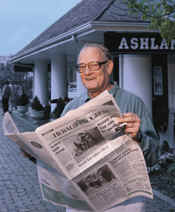
Jay Pace, my father-in-law, posing with The Herald Progress at the Ashland train station
       I always imagined I would read the Harry Potter series with my kids. Somehow, though, we never did; like me, they were never interested in the books. I watched as their friends dove into the culture and magic of Harry Potter. I took my kids to birthday parties bearing the theme, and so many of their friends have worn Harry Potter Halloween costumes. And yet, I still hadn't picked up the book. Over the years, I've had students marvel that I was an English teacher and hadn't read those books. "I just don't like that kind of book," I would tell them. I've had students who were required to read J.K. Rowling's work in college classes. One student even wrote her extended essay--a 1600 word essay students are required to write if they are pursuing the IB diploma--on Harry Potter and Shakespeare. I was intrigued by the topic, but I still hadn't picked up the book. At an elementary school book fair this winter, my son's principal approached me, also amazed that I hadn't read Harry Potter. After her encouragement, I bought Jack his own copy, and we were going to read it together. Yet, I never picked up the book; neither did my son.

      I'm not sure what made me make excuses for not reading Harry Potter for so long. Perhaps it was too mainstream. Perhaps it was knowing I wouldn't like it because I tend to like more realistic fiction. Perhaps it was the fact that if I read the first one, I would be committed to reading the entire series. Perhaps it was because it would make me remember my father-in-law, wishing he was here so that I could have discussed the book with him. Whatever it was, those excuses evaporated this year, as I found myself making a promise to one student I taught that I would read the book. I volunteered to supervise the Atlee Book Club this year, and the books they had selected for the final meeting were all books that I had read. "You could read Harry Potter, Mrs. Pace!" one of my students said, smiling. I didn't know how to tell her that I was scared to read that book--that I thought it would be too hard  personally. So, I smiled and told her I would. At her graduation I told her I had read three--no, not three of the books in the series--three chapters. I had started and made a promise to really read it over the summer and to give her a report.

     Like most English teachers, I have a pile of books to read this summer; I adore the unencumbered time this part of the year affords me to read. Harry Potter was carefully placed at the bottom of the stack--until I saw Toy Story 4. I promise not to give any spoilers to the movie in case you will go see it, but there was a line in that movie that stopped me in my tracks: "If you sit on a shelf the rest of your life, you'll never find out." Woody says this in the movie to one of the toys, encouraging her to take action. For fifteen years, I had left Harry Potter on both the literal and metaphorical shelf. I didn't know what I was missing. So, that afternoon, I stopped sitting on the shelf, moved Harry Potter to the top of my pile, and started reading.

     I learned much from reading Harry Potter this first week of summer. For one, I learned that I actually like the book. Dumbledore was the character who I admired most because of his sensibility and wisdom. I loved that  Hermione seemed so real because she was a rules follower who occasionally didn't follow the rules and found Harry to be an innately humble hero. Towards the end of the book, Dumbledore states, "It does not do to dwell on dreams and forget to live" (Rowling 214). I marveled at how much that sentence resonates with the line from Toy Story 4. Suddenly, Harry Potter motivated me in ways I never thought it would.

     I will admit, I still don't love the fantasy genre as a whole, but what I got out of reading Harry Potter was far more important. I learned that I can't make excuses for things that might seem difficult or out of reach. I can't put things off for a future date. I can't dream of what I want my life to be like; I've got to take action. I can't sit on the shelf for the rest of my life. When my father-in-law was living, he was the editor of the Herald Progress, a community newspaper that served much of Hanover County. A few times, Jay asked me to write an editorial for him. I was scared to do it in much the same way that I was scared to read Harry Potter after he died. I never did write for him. He would have loved the blog I started writing three years ago, though. This summer, I encourage you to do one thing that you've been putting off. Let if shift your perspective or change you positively. Let it help you grow as a person.

      Sadly, I never got to discuss  Harry Potter with my father-in-law, but I now know that's okay. For had I read this book when he asked me to read it, I most certainly would not have gained this perspective. I think I still might be sitting on that metaphorical shelf, forgetting to live--and what a rather unfortunate life that would be.


Sunday, June 2, 2019

A Yellow Brick Road Farewell

     When I was in high school, I was in the play The Wizard of Oz. While I aspired to be the Wicked Witch of the West and thought I had her cackle down, apparently according to the director, I wasn't "mean" enough. Instead, I landed the part of the munchkin (more than likely, my height helped me acquire this role). I learned to dance on my knees and even acquired a munchkin voice that comes in handy when I want to make my kids laugh or I need a random fun fact about myself in social situations. As a munchkin in Oz, I learned every single line of the play. I'm not sure why; if the Wicked Witch of the West got sick, I doubt they'd ever put me in. Still, to this day when The Wizard of Oz comes on t.v., I know the lines. When my father-in-law was alive, he could recite the movie as well. I remember when we discovered that we had this in common. We were watching the movie in the Outer Banks over Thanksgiving break. Finally, someone existed who wasn't annoyed that I could sing every note of the scarecrow's ballad of desiring a brain or talk like the Cowardly Lion, lamenting he was not king of the forest. There's one scene in particular that I always am drawn to, though--when Dorothy has to say goodbye to the Tin Man, the Scarecrow, and the Lion. The dialogue goes like this:


Dorothy: Goodbye, Tin Man. Oh, don't cry! You'll rust so dreadfully. Here's your oil can.
Tin Man: Now I know I've got a heart, 'cause it's breaking...
Dorothy: Goodbye, Lion. I know it isn't right, but I'm going to miss the way you used to holler for help before you found your courage.
Cowardly Lion: I never would've found it if it hadn't been for you...
Dorothy[to Scarecrow] I think I'm going to miss you most of all.

This scene sums up everything perfectly for me right now. My heart breaks to have to say goodbye to my students at the end of the school year. 

     I think about all of the goodbyes I've experienced in life--transitioning from a flip phone to a smart phone, saying goodbye to the mini van with too many miles on it. I've moved out of houses and said goodbye to friends who moved away. When I was thirteen, I let balloons go into the sky outside of my grandmother's hospital room--orbs of blue and yellow and pink floating among the clouds--as we prepared to say goodbye to her. I've shed pounds (unfortunately, only to welcome new ones back). I cry every time I back out of my parents' driveway, knowing I won't see them again for a few months. I've had to say goodbye to book characters who became my "friends" as I was reading and tv shows like Friends that were a staple in my high school and college days (thank goodness for Netflix). I know goodbyes are inevitable, but why does it take a brief moment to say hello and forever to say goodbye? Why are goodbyes so hard? This week, I will have to say goodbye to you, my students. While some of you I will be fortunate to have in Theory of Knowledge next year, many of you will never sit in my class again. Seniors, I'm not going to see you in the hallways on a daily basis. You're not going to put up with my memes There's no more tardy table and bells and elbowing crowded hallways. There's no more "us" as a class.

     The question I've been most asked by most people I've encountered recently is "You're a teacher; you must be ready for summer?" And while I need a break from essay grading, I have always had a hard time at the end of the year. Most people shake their head or laugh when I say this. I've even encountered a few eye rolls. 

Yet, I'm saying goodbye to so much:

one of the captains of the football team and several lacrosse players with some interesting new hairstyles.

the Editor-in-Chief and Photography Editor of the yearbook and some other yearbook staff members.

 a student venturing to Japan for college even though he doesn't speak Japanese (I have no doubt he'll be fluent shortly, though).

the creators of the Raider Readers book club and 9 of the top 10 ranked for their academics.

students passionate about politics.

a student who started a Special Olympics tennis league from the ground up.

a fearless jazzercise leader and two students who brought yoga to a local elementary school's field day.

a student who grades my memes regularly--and who has taught me so much (about meme making and life).

someone who taught inner city kids how to swim and provided them with swimsuits and goggles so they could do so.

one of the best drum majors and constant advocates of positivity.

a leader in the FFA.

a student who can construct a paper airplane far better than I can and another who is an expert at going on tangents.

a student with more nicknames than I can count on my fingers,and a gymnast who can far out flip anyone I know even when she's injured.

students who have mastered the water bottle flip, the marker flip, and even created a new system of math.


The Class of 2019


I say goodbye to 

readers and writers and also the students who read the Spark notes instead of the books.

students who are doing wonders for the Speak Up Club.

a bunch of show choir kids who have broken out in song in my first block class more than once.

 students who have taught me about texting shortcuts (fr). 

students who can banter beautifully about Classic rock.

I say goodbye to an EMT.

someone who successfully hijacked two powerpoints and who also made me my very own pair of shoes.

actors who light up the stage in theatre productions and improv.

table artists who leave me daily positive messages.

I say goodbye to 28 seniors, 86 juniors--114 people who have become my family. These are the people who have seen me at my best in the classroom but have also seen me at my worst and still accept me for the teacher I am. These are the leaders and athletes and artists and cultivators of kindness of Atlee High School. I say goodbye to people who inspire me to be better--1% better than the day before. I say goodbye to intelligent, strong, compassionate young people who I have been so lucky to teach.

Goodbyes are not easy. No one ever said they were. In one week, I will have completed 20 years of teaching. 20 years of hoping I made a difference. 20 years of faculty meetings, papers graded and relationships built. 20 years of saying goodbye.

In having to say goodbye, my heart breaks like the tin man.

Like the lion, you no longer need my help; you have the courage to move on.

And just as Dorothy returned to Kansas, I'll return to my classroom and shut the door when the last of my students leaves for the year. While I know there's no place like home, I also know the Class of 2019 will always be my scarecrow: I think I will miss you most of all. 

Juniors, make your senior year the best it can possibly be. Don't become complacent or give up too early. You are capable of such great things.

Class of 2019, go out and make a difference in this world as you have in my life. And know that it's hard to say goodbye because I love teaching you; I always will.